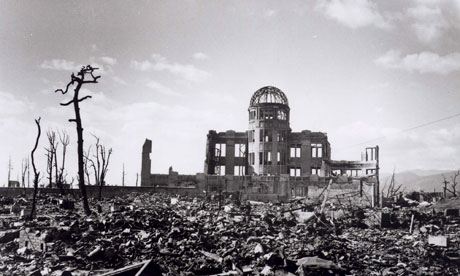
The full story is told for the first time in my book and e-book: Atomic Cover-Up: Two U.S. Soldiers, Hiroshima & Nagasaki and The Greatest Movie Never Made (Sinclair Books). This is a haunting account of how the shocking cover-up extended to President Truman, other presidents and the U.S. media. Footage shot by a Japanese newsreel team was also seized by the U.S. and buried. See a brief video with some of the footage below. David Friend of Vanity Fair calls it "a new work of revelatory scholarship and insight by Greg Mitchell that will speak to all of those concerned about the lessons of the nuclear age."
I've been writing about this subject for more than 30 years, driven by three facts: the U.S. still possesses 4400 nuclear warheads today and still has a "first-strike" policy; and nearly all of our top officials, and most in the media, continue to defend our use of the weapon in 1945, making it more likely they will be used again.
Atomic Cover-up takes a wide angle look at the use of the bomb in 1945--and its impact, other forms of official cover-up, and American opinion, right up to the present day. You can buy the e-book edition for Kindle, all phones, Blackberry, iPad, Macs and PCs (for just $3.99) via Amazon, and you do not need a Kindle. Print edition also available via Amazon.
And don't miss the wild Hollywood angle -- when the Truman White House censored the first major movie about The Bomb, from MGM, and even got the actor playing Truman fired! It's the subject of my current e-book Hollywood Bomb.
Why did the cover-up of the film footage matter? While Americans were denied important truths about The Bomb -- filmed by their own military -- a costly nuclear arms race ensued, nuclear power became entrenched, and millions of Americans (and many soldiers) were exposed to dangerous levels of radiation in our own country. Email me at: epic1934@aol.com. The video trailer below. --G.M.


11 comments:
thank you for posting this and sharing, heartbreaking to watch. the guilty always try to hide their actions. It is clear why they hid this from the world.
So the argument goes on. Were the Bombs Necessary? The better question might be, were they effective?
Some say there was some hidden agenda in the US bombing of Hiroshima and Nagasaki. Permit me to present an alternate view and proffer an answer.
Some might be advised to listen to President Truman explain it in his own words. “Having found the bomb,” Truman said, ”we have used it…we have used it to shorten the agony of young Americans.”
Now there are those who say, including former Ambassador John Kenneth Galbraith that the atom bombs were not necessary because the war was ending anyway. The A-bombs made he said, and I quote, “made a difference at most, of two or three weeks.” But at that time, with no surrender on the horizon, the kamikazes continued to strike, sinking American vessels – the Indianapolis was sunk taking the lives of 880 young Americans, and Allied casualties were running 7000 a week. Two more weeks meant 14,000 dead and wounded, three more weeks meant 21,000.
During the intervening period between the Nagasaki bomb and the final surrender on August the 15th, the war went on as usual. On August the 12th eight American fliers were executed (beheaded). The USS Bonefish went down with all of its crew. The destroyer Callaghan went down, and the destroyer Escort Underhill was lost. That’s just six days of allied agony that we are asked to disregard, if we accept the waiting period proposed by the bomb apologists.
It is also a forgotten reality today is that in 1945 the entire Japanese populace was held in the thrall of an immense military machine. The Japanese had a pre-invasion patriotic song, “One Hundred Million Souls for the Emperor,” and it meant just that. A Universal and National Kamikaze was a direct threat and the explicit intent.
Further to this debate, the Japanese government announced in 1945 that all Japanese women from the ages of seventeen to forty were to be called up to repel the Allied invasion.
Additionally, Japanese prison-camp commanders received a significant order in 1945 from Japanese Field Marshal Terauchi that unequivocally stated that the moment the Allies invaded the main Japanese islands; all prisoners were to be killed. This field command is also a matter of record. I submit the bombs saved not only the prisoners lives but also the lives of millions of truly innocent Japanese civilians who would have certainly perished in this failed attempt at empire – a lost cause.
Finally, the bomb was not dropped without warning. Fully two days before the bombings, over 700,000 leaflets were dropped over Japan warning the people to give it up (as was promised in Potsdam) or be utterly destroyed and obliterated. They failed to heed the warning.
No, I suggest people should reconsider this take on history. If we are to follow his line of reasoning, then we have to accept the preposterous assumption that it would have been better for America and its allies to suffer thousands of additional casualties, in order to save enemy lives.
Some wars are better lost than won. World War II is a classic example.
ThaiGold just forgot who was killed in H and N - civilians and not soldiers in combat; no difference for ThaiGold ...
Greg, Thanks for your good efforts here, but wasn't at least some of this previously released & known from the extensive work of the ABCC? I've seen still pictures of the devastation and injuries for decades. Is the novelty the perviously censored color films? Much of what was on the film I suspect has been available in one form or another. I imagine the shock of the whole thing on film for the 1st time is what was bothering the original censors, which was not uncommon for the time. And yes that sentiment carried on for 'quite awhile' too. Thanks again, JMP
I'm late to the debate, I know...
The Japanese people, under the sway of a right-wing nationalistic movement, probably wouldn't have surrendered without seeing the destructive might of the atomic bombs.
Hiroshima and Nagasaki were "sold" as legitimate targets on the false basis they were "military targets".
The Japanese government were trying to surrender through Russian channels, but they weren't going far enough for the "unconditional surrender" demands placed on them, so they were being ignored.
Regarding the first fact... why not drop the bomb in the ocean, and say, "the next one will be on land"? Or why not drop it on Mount Fuji, a potent symbol for the Japanese?
ThaiGold's argument that it "saved American lives" is one of those platitudes that falls apart when you ask, "why would we need to stage a ground invasion after we destroyed their fleet, their army, and their airforce?" A defeated and surrounded nation was no longer a threat, even if women were called upon to defend their homeland.
And ThaiGold's mention of the pamphlet drop is perverse... how could the people force their right-wing Nationalist regime to surrender? At best that was a warning that they'd be utterly destroyed without a say in the matter.
ThaiGold prefers to blame the victims so he can side with the aggressor and be absolved of guilt. I'm just glad we had a wise leader like Ike to wind down the Korean War without dropping the bombs (as his military commanders were urging).
Mitchell: A good friend & colleague recently gave me your book “Atomic Cover-up” exclaiming this is a “great” read. Half way through the book I was quite convinced (& annoyed) that it was more an indictment of the US & those who chose to use the bombs than an instrument or argument for nuclear disarmament or “peace” – which it should have been. Rather than condemn or trivialize the arguments of the big wigs that decided to use the bombs (subliminally or by direct implication), perhaps you should have spent more time seeking out & interviewing those involved in the island-hopping campaigns in the Pacific, were Japanese POWs, victims of Unit 731 atrocities on the Asian Mainland, or were destined to invade the Japanese homeland. Perhaps then you may have been a bit more sympathetic to those who advocate(d) use of the bombs. As Paul Fussell stated (I’m paraphrasing) – they (the bombs) not only saved thousands of American lives – they saved MY life! – (by not having to invade the fanatical Japanese homeland).
As a drafted grunt in Vietnam, I was witness to similar atrocities (albeit not on the scale of a nuclear holocaust) committed by humans (seldom US forces) & the waste of life & limb associated with ground combat operations. In the midst of “the shit”, I would gladly have supported a nuke strike on Hanoi & Haiphong – hell, all of North Vietnam if it had helped my platoon mates survive & retain my left arm & leg left in the Central Highlands. Is the obscenity of war only related to scale? How can you condemn those who ended a massive slaughter (in deference to US lives) quickly? A bit Machiavellian I guess, but in the words of the greatest General in US history (William Tecumseh Sherman) “War is cruelty. The crueler it is, the sooner it will be over.”
I wish you had written your book more in this context rather than your guiltless (you), apologist attitude. You could have driven home your point more from viewing it as “we needed to stop those damn racist Japanese ASAP but we had no idea what the hell were unleashing”. The result was a realization (your & film data) that this shit should never be unleashed again.
The worse is how it affects the mothers that give birth years later to child. The damage never ends. It was so stupid it happened.
Your theory is all wrong. The Russian invasion of Manchuria effectively ended any resupply of the Japanese military. The Japanese were ready to surrender in May 1945 and Truman knew it before the bombs were dropped - look it up instead of believing the BS peddled by your military. In a Speech at the Washington Monument on October 5, 1945, Admiral Nimitz stated "The Japanese had, in fact, already sued for peace before the atomic age was announced to the world with the destruction of Hiroshima and before the Russian entry into the war." Every year during August people keep pushing the myth of justification of saving lives that does not stand up to any real examination of the documentary evidence.
The fact that Truman lied in describing Hiroshima as a military base says everything you need to know. He'd committed the most despicable war crime in human history, and he knew it.
People who try to rationalize punishing innocents for the brutality of their military put themselves in the moral company of Al Qaeda.
It was a disaster and we should accept it. There was no need to kill tens of thousands innocent civilians to win a war. History says that there were other ways to end this conflict.
And now, sitting in the White House, is a bellicose mentality that has never seen combat except on film or smelled the stench of death, nor heard the cries of women and children. And one who brags, berates, mocks, and pushes another maniac toward pushing a button for launching a fire and fury that would solve an egotistical bravado with no relation to reason or morality. God help us. Our generals help us. Unless they are nihilists themselves, they may be the only ones to say “stand down” on first strike.
Post a Comment