For The Beginning or the End: How Hollywood--and America--Learned to Stop Worrying and Love the Bomb.
Thursday, July 30, 2020


Tuesday, July 28, 2020
Hersey's "Hiroshima" and the Aftermath

Three major excerpts from the book related to Hersey have been published this month, and here are the convenient links:
At Lit Hub, how the story came to be and the immediate highly positive response, which imperiled the official narrative justifying the killing of 200,000 civilians.
At Mother Jones, how Truman and his allies plotted to counter it via a cover story in another famous magazine, Harper's, and largely succeeded.
Now at the Daily Beast we find a legendary editor of The New Yorker pleading with the White House to get Truman to read, or at least look at, the article, two months later. We still don't know if he ever did.
Also, spoiler alert--the book ends with Hersey reading an excerpt from his article at the LBJ White House--as an anti-Vietnam protest and warning about future wars and other nuclear holocausts.
Monday, July 27, 2020
Documenting the "Atomic Cover-up"

The new film reveals the suppression of sensational, and vitally important, film footage, starting in 1946. Top U.S. officials and the military buried the only color footage shot in Hiroshima and Nagasaki after the bombings--by an elite U.S. Army film team--as well as the most historic B&W footage shot by the top Japanese newsreel crew. I first uncovered this many years ago. Directing a film about it, using the long-hidden images and the haunting first-person accounts of the men, Japanese and American, who shot the footage, has now been realized in a unique and powerful yet (I believe) artful way. I wrote an article detailing all this, just published. For more info, you can contact me at: gregmitch34 (at) gmail (dot) com.
The doc is presently 52 minutes long. I am co-producer along with Suzanne Mitchell (no relation). Charlie Seaborn composed an original score. Rob Burgos edited. Among the advisers are Academy Award-winning director Alex Gibney, Pulitzer-winning historian Martin Sherwin, actor/director Alex Winter and the leading American authority on the B&W footage, Abe Markus Nornes.
Here are the four clips. The first one features the leader of the American film team and some of that color footage from Hiroshima. The second reveals how the Japanese footage was seized by the U.S.--but then they hid a print in a ceiling for six years. Then a second American film-maker visits doctors and nurses responding to the post-bomb disaster, echoed today in the Covid-19 crisis. In the final clip he attempts to get the footage, still classified top secret, released, for three decades, approaching everyone from Edward R. Murrow to former President Harry S. Truman himself. And again: my new book reveals the same sort of suppression in the story of how the Truman White House and military ordered MGM to make key cuts and revisions in the first drama about the bombings to defend the use of the weapons against Japan--and build more of them...order here or elsewhere....
Sunday, July 26, 2020
Roots of Radioactivity
Watched the new Amazon movie Radioactive with Rosamund Pike as Marie Curie with great interest, knowing relatively little about the lives of the Curies and exactly how they discovered radium. Expected a good bio-pic with a fine actress and indeed it was well done if not fully developed. But what was rather shocking was how often it flashed forward to the rather negative results (along with the positive) of her work.
So we saw the pilot of the Enola Gay carrying the first atomic bomb to Hiroshima--and remarkably a rather view in America of a Hiroshima street scene with average folks about to be pulverized. A little later in the movie we are at a U.S. nuclear test site in Nevada in 1961 with people paying to watch the blast and a fake suburban village constructed to absorb the blow. Then, a little later: Chernobyl. A Hiroshima victim re-appears in a fantasy sequence at the end of the film.
That's more "Hiroshima" content than we have seen in a mainstream in America in...decades. And that's the very subject of my new book.
So we saw the pilot of the Enola Gay carrying the first atomic bomb to Hiroshima--and remarkably a rather view in America of a Hiroshima street scene with average folks about to be pulverized. A little later in the movie we are at a U.S. nuclear test site in Nevada in 1961 with people paying to watch the blast and a fake suburban village constructed to absorb the blow. Then, a little later: Chernobyl. A Hiroshima victim re-appears in a fantasy sequence at the end of the film.
That's more "Hiroshima" content than we have seen in a mainstream in America in...decades. And that's the very subject of my new book.
Friday, July 17, 2020
Countdown to Hiroshima: X-Minus-20 Days
Yesterday in my annual series the highlight was the first nuclear test, at Trinity, on that date 76 years ago. The following day, in Potsdam, Truman met Stalin for the first time, and had a new bounce in his step after receiving word of the positive test.
 Still, he had to insist that the Soviets keep their promise to enter the war by mid-August for he knew, as he wrote in his diary at Potsdam, that would mean "fini Japs" when that occurred--even without use of the atomic bomb. So Truman recognized, in real time, the crucial and possibly war-ending importance of the Soviet move--even if many historians and most in media have ignored or underplayed that since. (See my slightly deeper analysis here.)
As it would turn out, he decided not to wait for Stalin but chose to use the bomb first (and then a second time even as the Soviets kept their promise and declared war on Japan).
Also today Gen. Leslie Groves, who managed the Manhattan effort, sent a long and detailed memo to Secretary of War Stimson on the Trinity test, which included eyewitness accounts by scientists and what would become a decades-long theme: downplaying the negative effects of radiation. "It was followed and monitored by medical doctors and scientists with instruments to check its radioactive effects. While here and there the activity on the ground was fairly high, at no place did it reach a concentration which required evacuation of the population."
He did have to admit: "Radioactive material in small quantities was located as much as 120 miles away. The measurements are being continued in order to have adequate data with which to protect the Government's interests in case of future claims."
My third book on this subject was published last year: The Beginning or the End: How Hollywood--and America--Learned to Stop Worrying and Love the Bomb.

As it would turn out, he decided not to wait for Stalin but chose to use the bomb first (and then a second time even as the Soviets kept their promise and declared war on Japan).
Also today Gen. Leslie Groves, who managed the Manhattan effort, sent a long and detailed memo to Secretary of War Stimson on the Trinity test, which included eyewitness accounts by scientists and what would become a decades-long theme: downplaying the negative effects of radiation. "It was followed and monitored by medical doctors and scientists with instruments to check its radioactive effects. While here and there the activity on the ground was fairly high, at no place did it reach a concentration which required evacuation of the population."
He did have to admit: "Radioactive material in small quantities was located as much as 120 miles away. The measurements are being continued in order to have adequate data with which to protect the Government's interests in case of future claims."
My third book on this subject was published last year: The Beginning or the End: How Hollywood--and America--Learned to Stop Worrying and Love the Bomb.
Countdown to Hiroshima: X-Minus-21 Days

Before going forward, one of President Truman's top advisers, Ralph Bard, deserves mention here.
He was Under Secretary of the Navy and also a member of the Interim Committee, which had advised Truman in June that he should approve the use of the bomb against Japanese cities as soon as it was tested (which would come on July 16, 1945) and ready. Bard sent Secretary of War the following memo and also may have met with Truman to discuss it (there is some debate about this). He remained convinced until the end of his life that Truman should have followed his advice. In fact, many historians believe that he is correct. His three-angled proposal included warning the Japanese that the Soviets would likely declare war against them soon (which they did, just after Hiroshima); and to offer assurances that they could keep their emperor as a symbolic leader (which we okayed but only have we got a chance to use two of the new weapons).
Ever since I have been in touch with this program I have had a feeling that before the bomb is actually used against Japan that Japan should have some preliminary warning for say two or three days in advance of use. The position of the United States as a great humanitarian nation and the fair play attitude of our people generally is responsible in the main for this feeling.
During recent weeks I have also had the feeling very definitely that the Japanese government may be searching for some opportunity which they could use as a medium of surrender. Following the three-power conference emissaries from this country could contact representatives from Japan somewhere on the China Coast and make representations with regard to Russia's position and at the same time give them some information regarding the proposed use of atomic power, together with whatever assurances the President might care to make with regard to the Emperor of Japan and the treatment of the Japanese nation following unconditional surrender. It seems quite possible to me that this presents the opportunity which the Japanese are looking for.
I don't see that we have anything in particular to lose in following such a program. The stakes are so tremendous that it is my opinion very real consideration should be given to some plan of this kind. I do not believe under present circumstances existing that there is anyone in this country whose evaluation of the chances of the success of such a program is worth a great deal. The only way to find out is to try it out.
Thursday, July 16, 2020
75 Years Ago: How 'NYT' Reporter Helped Cover-Up Radiation Dangers
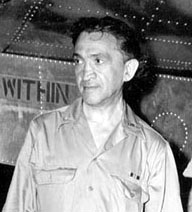
But today marks the 75th anniversary of the first atomic test, at Trinity, which he revealed only after the Hiroshima blast, and then downplaying the radiation dangers here at home. As I've written: "Here was the nation’s leading science reporter, severely compromised, not only unable but disinclined to reveal all he knew about the potential hazards of the most important scientific discovery of his time."
A key moment came a month later when, with a few other reporters, he was taken by General Leslie Groves, head of the Manhattan Project, to the crater created by the Trinity blast. His report in the Times would again pooh-pooh radiation effects. Soon a young soldier sent into the crater would die. Here is my recent article, with excerpt below. And my new book covers the test and cover-up and much more in that vein, The Beginning or the End: How Hollywood--and America--Learned to Stop Worrying and Love the Bomb.
*****
On September 9, 1945, Laurence toured the Trinity test site, in New Mexico, where the United States tested its first atomic weapon on July 16, with General Leslie Groves and physicist J. Robert Oppenheimer. The top-secret area finally had been opened to journalists.
Two weeks earlier, President Truman’s secretary, Charles G. Ross, had sent a memo to the War Department urging the military to recruit a group of reporters to explore the test site. "This might be a good thing to do in view of continuing propaganda from Japan," Ross wrote.
Now General Groves, who believed the reports of radiation disease from Japan were a “hoax,” was personally escorting some of the newsmen near ground zero. His driver, a young soldier named Patrick Stout, spent several minutes in the crater of the blast and was photographed, smiling.
Laurence’s account of this visit (delayed three days until September 12 due to a censorship review) disclosed quite frankly why he and thirty other journalists had been invited: to "give lie to" Japanese “propaganda” that ” radiations were responsible for deaths even after" the Hiroshima attack, as he wrote. He quoted General Groves calling any deaths by radiation in Japan as “very small.” (In truth, the total was probably 20,000 or more in the two bombed cities.)
General Groves had expressly asked the reporters to assist him in this effort, and they did not disappoint him. (He was also in the process of securing script approval on that MGM movie about the bomb.) Geiger counters showed that surface radiation, after nearly two months, had "dwindled to a minute quantity, safe for continuous human habitation," Laurence asserted. He did introduce one bit of contrary information: the reporters had been advised to wear canvas overshoes to protect against radiation burns.
The press tour, in fact, had "an oddly reassuring effect," the New York Times observed in an editorial. Still, a scientist informed the young soldier, Patrick Stout, who stood in the crater during the press tour, that he had been exposed to dangerous levels of radioactivity. Twenty-two years later Stout became ill and was diagnosed with leukemia. The military, apparently acknowledging radiation as the cause, granted him "service-connected" disability compensation. Stout died in 1969.
Tuesday, July 14, 2020
That 'Enola Gay' Exhibit

Some of you may recall the widely-publicized scenario: The Museum had attempted to mount the first balanced, full and accurate historical reckoning of the atomic bombing of Japan, for the 50th anniversary, in an exhibit surrounding the triumphalist, first partial (front half) display of the restored bomber that dropped the new weapon over Hiroshima, the Enola Gay. When right-wing media and congress members and veterans groups were leaked an early script, they went ballistic (so to speak). The Air Force Assn. charged that it treated Japan and the U.S. "as if their participation in the war were morally equivalent,” which was nonsense. Sen. Nancy Kassebaum (R-Kans.) sent a letter to the Smithsonian calling the exhibit (which no one had seen yet) “a travesty.”
All of these sorts successfully brought pressure on the Smithsonian (and White House) to force a complete rewrite, so that the exhibit became a one-note, and historically inaccurate, glorification of the bombing with no shades of doubt.
Then they forced the canceling of the entire exhibit so the plane, in all its glory, stood alone. As one of the curators, Tom Crouch, complained-- critics of the exhibit had a “reluctance to really tell the whole story. They want to stop the story when the bomb leaves the bomb bay.”
Now the bomber sits, fully restored, in an annex in the suburbs, for visitors who arrive.
I was intimately involved for months in the push-back, attended meetings in D.C. with the museum director, and more, to no avail (even witnessed civil disobedience at the museum on the day the exhibit opened). Anyway: Too much to recount, but here's a link to a letter that we wrote (signed by many historians) and sent to the Smithsonian director. My new book, The Beginning or the End: How Hollywood--and America--Learned to Stop Worrying and Love the Bomb very much speaks to this kind of denial and suppression.
Saturday, July 11, 2020
From Hiroshima to Hollywood

Wall Street Journal hailed the book in a review today. Other reviews have also been terrific. Here is one from often-tough Kirkus: "Excellent research and rich dialogue give Mitchell’s book a novelistic flair....Reel film meets real history in this scintillating tale." Major excerpts just appeared at LitHub and Mother Jones with more coming at Daily Beast, American History, Washington Monthly and elsewhere. Again, click to order here.
Here are five "blurbs," from the leading authority on the bomb, Richard Rhodes, and best-selling authors Gary Krist, Peter Biskind, Nicholson Baker, and Alex Kershaw. The new book, of course, marks the 75th anniversary of the creation and use of the bomb against Japan. I will also note that I have just finished writing and directing my first film, based on a previous book, Atomic Cover-Up. You can contact me at: gregmitch34 (at) gmail (dot) com.
"The Beginning or the End is an engrossing, wry, and always lively look behind the scenes of a historic Hollywood flop. But it’s also much more than that: a deeply serious, meticulously researched account of how the movie industry—and the American public in general—embraced a comforting myth to justify one of the most controversial decisions in history. This is a first-rate piece of work by one of our most accomplished nonfiction storytellers.” --Gary Krist, best-selling author of Empire of Sin and The Mirage Factory
"A story of dishy Hollywood doings but with atomic bombs and a screenplay by Ayn Rand—what more could a reader ask for?" -- Richard Rhodes, The Making of the Atomic Bomb, winner of the Pulitzer Prize and National Book Award
"From the nation's top secret to the silver screen: Mitchell tells an unforgettable tale about a forgotten film and the tug-of-war between scientists, the White House and the Pentagon over the Hollywood version of the bombing of Hiroshima.”—Peter Biskind, best-selling author of Easy Riders, Raging Bulls
"A fascinating and brilliantly researched account of how Hollywood and Washington grappled with how to portray and profit from the new nuclear age. Another great read and exposé from Mitchell." --Alex Kershaw, best-selling author of The Liberator and Avenue of Spies
“Mitchell expertly chronicles the gradual transformation of a gigantic, and still-radiating, moral catastrophe." --Nicholson Baker, author of Human Smoke: The Beginnings of World War II, and Double Fold, winner of the National Book Critics Circle Award
 "Mitchell shows how this desire to control the narrative around the
atomic attacks fed into the U.S.’s continued insistence on its right to
launch a nuclear first strike. While the film bombed at the box office,
Mitchell’s rich account of its making and larger implications should
draw both history buffs and those concerned with the continuing issues
around nuclear weapons."
"Mitchell shows how this desire to control the narrative around the
atomic attacks fed into the U.S.’s continued insistence on its right to
launch a nuclear first strike. While the film bombed at the box office,
Mitchell’s rich account of its making and larger implications should
draw both history buffs and those concerned with the continuing issues
around nuclear weapons."
--Publishers Weekly

"This intriguing, behind-the-scenes look at a disjointed creative partnership is sure to be of interest to readers of history and cinema." --Library Journal
"Excellent research and rich dialogue give Mitchell’s book a novelistic flair....Reel film meets real history in this scintillating tale."--Kirkus Reviews
"Seriously, this is a great book." -- Kurt Eichenwald, author of The Informant and Conspiracy of Fools
"Fascinating but also, weirdly, enjoyable to read." -- Harry Shearer
"A great new book that you're going to want to read. The book conjures up a compelling cast of characters who got caught in the Cold War propaganda machine." -- Will Bunch, Philadelphia Inquirer
"A book that features both J. Robert Oppenheimer AND Donna Reed has to be good."-- Dan Barry
From the publisher's catalog:
Soon after atomic bombs exploded over Hiroshima and Nagasaki in 1945, MGM set out to make a movie studio chief Louis B. Mayer called “the most important story” he would ever film: a big budget dramatization of the Manhattan Project and the invention and use of the revolutionary new weapon.
Greg Mitchell’s The Beginning or the End
chronicles the first efforts of American media and culture to process
the Atomic Age. A movie that began as a cautionary tale inspired by
atomic scientists aiming to warn the world against a nuclear arms race
would be drained of all impact due to revisions and retakes ordered by
President Truman and the military—for reasons of propaganda, politics,
and petty human vanity (this was Hollywood). And all the
while, the FBI was surveillng Oppenheimer, Albert Einstein, Leo Szilard
and other scientists for "Communist" connections.
Mitchell
has found his way into the lofty rooms, from Washington to California,
where it happened, unearthing hundreds of letters and dozens of scripts
that show how wise intentions were compromised in favor of defending the
use of the bomb and the imperatives of postwar politics. As in his
acclaimed Cold War true-life thriller The Tunnels, he exposes how our implacable American myth-making mechanisms distort our history.
"Greg Mitchell is the best kind of historian, a true storyteller."
—Kai Bird, Pulitzer Prize-winning author of American Prometheus: The Triumph and Tragedy of J. Robert Oppenheimer
"Greg Mitchell has been a leading chronicler for many years of Hiroshima and Nagasaki, and American behavior toward them."
—Robert Jay Lifton, author of Death in Life (winner of the National Book Award).
Friday, July 10, 2020
Another Death at Los Alamos
I've been posting brief excerpts from my book, The Beginning or the End, just published, some of which go far beyond the main subject--the perversion of the original vision for the MGM drama on the bomb due to orders from the White House and military. Here, still in 1946, I explore the death of a second scientist at Los Alamos, on May 30 of that year. The earlier Daghlian accident had been covered up by the government and later attributed to "burns."
*
Less than a year after Harry Daghlian died after being exposed to radiation (photo below), Los Alamos witnessed a second fatal accident during a criticality experiment gone wrong. This was the brilliant Canadian native Louis Slotin, age thirty-five, who had helped arm the Hiroshima bomb and then the core slated to be used in the first Bikini blast, which he had planned to witness.

Enrico Fermi had warned Slotin months earlier that if he continued his risky criticality experiments--known as "tickling the tiger's tail"--he would be dead within a year. Unlike the solo Daghlian accident, this time eight Los Alamos personnel were exposed to the radiation, with Slotin getting far the worst of it. As Slotin lingered near-death for days, the government planned to avoid citing radiation as the culprit in any public statements--just as it had done after the Daghlian tragedy. Then his friend, the physicist Philip Morrison (who had witnessed even worse in Hiroshima), insisted on an honest reckoning.
In The Beginning or the End, Matt Cochran would miraculously die within a day, while Slotin would experience nine days of suffering; the others exposed would survive. When his passing was announced, Slotin was commonly referred to as "the first peacetime victim" of radiation from the bomb project. To balance the horrors of what nuclear accidents might mean for the future, officials played up the "hero" angle--how Slotin had maybe saved the others by sacrificing himself, reaching in and separating components to halt the runaway atoms. General Groves had written a note to him before he died hailing his "heroic actions" and dispatched a military plane to bring his parents to his bedside.
The Time headline called him "Hero of Los Alamos" but admitted that radiation releases "may become a familiar factor in the atomic age." Read about or order the book here, thanks.
Thursday, July 9, 2020
Hiroshima Pilot Didn't Lose Any Sleep Over It
Paul W. Tibbets, pilot of the plane, the "Enola Gay" (named for his
mother), which dropped the atomic bomb over Hiroshima on August 6, 1945. died at 92 in 2007, defending the bombing to the end of his life.
Some of the obits noted that he had requested no funeral or headstone
for his grave, not wishing to create an opportunity for protestors to
gather.
I had a chance to interview Tibbets nearly 30 years ago, and wrote about it for several newspapers and magazines and in my book published this week, THE BEGINNING OR THE END: How Hollywood--and America--Learned to Stop Worrying and Love the Bomb, Later I got to meet and sit next to the pilot who dropped the bomb over Nagasaki, Charles Sweeney, on Larry King's CNN show. I wonder how many other writers have met both of them (and also journeyed to the two atomic cities and met dozens of survivors).
The hook for the Tibbets interview was this: While spending a month in Japan on a grant in 1984, I met a man named Akihiro Takahashi. He was one of the many child victims of the atomic attack, but unlike most of them, he survived (though with horrific burns and other injuries), and grew up to become a director of the memorial museum in Hiroshima.
Takahashi showed me personal letters to and from Tibbets, which had led to a remarkable meeting between the two elderly men in Washington, D.C. At that recent meeting, Takahashi expressed forgiveness, admitted Japan's aggression and cruelty in the war, and then pressed Tibbets to acknowledge that the indiscriminate bombing of civilians was always wrong.
But the pilot (who had not met one of the Japanese survivors previously) was non-committal in his response, while volunteering that wars were a very bad idea in the nuclear age. Takahashi swore he saw a tear in the corner of one of Tibbets' eyes.
 So, on May 6, 1985, I
called Tibbets at his office at Executive Jet Aviation in Columbus,
Ohio, and in surprisingly short order, he got on the horn. He
confirmed the meeting with Takahashi (he agreed to do that only out of
"courtesy") and most of the details, but scoffed at the notion of
shedding any tears over the bombing. That was, in fact, "bullshit."
So, on May 6, 1985, I
called Tibbets at his office at Executive Jet Aviation in Columbus,
Ohio, and in surprisingly short order, he got on the horn. He
confirmed the meeting with Takahashi (he agreed to do that only out of
"courtesy") and most of the details, but scoffed at the notion of
shedding any tears over the bombing. That was, in fact, "bullshit."
"I've got a standard answer on that," he informed me, referring to guilt. "I felt nothing about it. I'm sorry for Takahashi and the others who got burned up down there, but I felt sorry for those who died at Pearl Harbor, too....People get mad when I say this but -- it was as impersonal as could be. There wasn't anything personal as far as I?m concerned, so I had no personal part in it.
"It wasn't my decision to make morally, one way or another. I did what I was told -- I didn't invent the bomb, I just dropped the damn thing. It was a success, and that's where I've left it. I can assure you that I sleep just as peacefully as anybody can sleep." When August 6 rolled around each year "sometimes people have to tell me. To me it's just another day."
In fact, he wrote in his autobiography, The Tibbets Story, that President Truman at a meeting in the White House after the bombing had instructed him not to lose any sleep over it. "His advice was appreciated but unnecessary," Tibbets explained.
In any event, Tibbets (like Truman) had acted in a consistent manner for decades, while at times traveling under an assumed name to avoid scrutiny. After the war he called Hiroshima and Nagasaki "good virgin targets" -- they had been untouched by pre-atomic air raids -- and ideal for "bomb damage studies." In 1976, as a retired brigadier general, he re-enacted the Hiroshima mission at an air show in Texas, with a smoke bomb set off to simulate a mushroom cloud. He intended to do it again elsewhere, but international protests forced a cancellation.
He told a Washington Post reporter, for a favorable profile, in 1996, "For awhile in the 1950s, I got a lot of letters condemning me...but they faded out." On the other hand, "I got a lot of letters from women propositioning me."
In THE BEGINNING OR THE END: How Hollywood--and America--Learned to Stop Worrying and Love the Bomb, I recall Tibbets' role as a paid consultant to the 1953 Hollywood movie, Above and Beyond, with Robert Taylor in the pilot role. In the key scene, after releasing the bomb and watching Hiroshima go up in flames below, Taylor radios in a strike report. "Results good," he says. Then he repeats it, bitterly and with grim irony.
But that was not in the Tibbets-approved original script for the film. It was added later, presumably to show that the men who dropped the bomb recognized the tragic nature of their mission.
Tibbets criticized the scene when the film came out.
I had a chance to interview Tibbets nearly 30 years ago, and wrote about it for several newspapers and magazines and in my book published this week, THE BEGINNING OR THE END: How Hollywood--and America--Learned to Stop Worrying and Love the Bomb, Later I got to meet and sit next to the pilot who dropped the bomb over Nagasaki, Charles Sweeney, on Larry King's CNN show. I wonder how many other writers have met both of them (and also journeyed to the two atomic cities and met dozens of survivors).
The hook for the Tibbets interview was this: While spending a month in Japan on a grant in 1984, I met a man named Akihiro Takahashi. He was one of the many child victims of the atomic attack, but unlike most of them, he survived (though with horrific burns and other injuries), and grew up to become a director of the memorial museum in Hiroshima.
Takahashi showed me personal letters to and from Tibbets, which had led to a remarkable meeting between the two elderly men in Washington, D.C. At that recent meeting, Takahashi expressed forgiveness, admitted Japan's aggression and cruelty in the war, and then pressed Tibbets to acknowledge that the indiscriminate bombing of civilians was always wrong.
But the pilot (who had not met one of the Japanese survivors previously) was non-committal in his response, while volunteering that wars were a very bad idea in the nuclear age. Takahashi swore he saw a tear in the corner of one of Tibbets' eyes.
 So, on May 6, 1985, I
called Tibbets at his office at Executive Jet Aviation in Columbus,
Ohio, and in surprisingly short order, he got on the horn. He
confirmed the meeting with Takahashi (he agreed to do that only out of
"courtesy") and most of the details, but scoffed at the notion of
shedding any tears over the bombing. That was, in fact, "bullshit."
So, on May 6, 1985, I
called Tibbets at his office at Executive Jet Aviation in Columbus,
Ohio, and in surprisingly short order, he got on the horn. He
confirmed the meeting with Takahashi (he agreed to do that only out of
"courtesy") and most of the details, but scoffed at the notion of
shedding any tears over the bombing. That was, in fact, "bullshit.""I've got a standard answer on that," he informed me, referring to guilt. "I felt nothing about it. I'm sorry for Takahashi and the others who got burned up down there, but I felt sorry for those who died at Pearl Harbor, too....People get mad when I say this but -- it was as impersonal as could be. There wasn't anything personal as far as I?m concerned, so I had no personal part in it.
"It wasn't my decision to make morally, one way or another. I did what I was told -- I didn't invent the bomb, I just dropped the damn thing. It was a success, and that's where I've left it. I can assure you that I sleep just as peacefully as anybody can sleep." When August 6 rolled around each year "sometimes people have to tell me. To me it's just another day."
In fact, he wrote in his autobiography, The Tibbets Story, that President Truman at a meeting in the White House after the bombing had instructed him not to lose any sleep over it. "His advice was appreciated but unnecessary," Tibbets explained.
In any event, Tibbets (like Truman) had acted in a consistent manner for decades, while at times traveling under an assumed name to avoid scrutiny. After the war he called Hiroshima and Nagasaki "good virgin targets" -- they had been untouched by pre-atomic air raids -- and ideal for "bomb damage studies." In 1976, as a retired brigadier general, he re-enacted the Hiroshima mission at an air show in Texas, with a smoke bomb set off to simulate a mushroom cloud. He intended to do it again elsewhere, but international protests forced a cancellation.
He told a Washington Post reporter, for a favorable profile, in 1996, "For awhile in the 1950s, I got a lot of letters condemning me...but they faded out." On the other hand, "I got a lot of letters from women propositioning me."
In THE BEGINNING OR THE END: How Hollywood--and America--Learned to Stop Worrying and Love the Bomb, I recall Tibbets' role as a paid consultant to the 1953 Hollywood movie, Above and Beyond, with Robert Taylor in the pilot role. In the key scene, after releasing the bomb and watching Hiroshima go up in flames below, Taylor radios in a strike report. "Results good," he says. Then he repeats it, bitterly and with grim irony.
But that was not in the Tibbets-approved original script for the film. It was added later, presumably to show that the men who dropped the bomb recognized the tragic nature of their mission.
Tibbets criticized the scene when the film came out.
When Jon Stewart Apologized For Questioning Use of Atomic Bomb
Many Americans, past and present, who endorse, if often uneasily, the use of an atomic bomb to destroy the city of Hiroshima almost 75 years ago, have little problem raising questions about the second bomb. On August 9, 1945, three days after the Hiroshima blast, the second atomic bomb was dropped over Nagasaki, killing another 90,000, almost all of them civilians (or Dutch POWs), the vast majority women and children.
My new book, The Beginning or the End: How Hollywood--and America--Learned to Stop Worrying and Love the Bomb, covers the Nagasaki bombing (among other things) but also raises important questions about how even today few media commentators feel free to criticize the use of the bomb back in 1945.
 Let's take as just one example an episode in the spring of 2009 featuring, of all people, Jon Stewart. One night he bravely (if off-handedly) suggested that
President Harry Truman was a "war criminal" for using the atomic bomb
against Japan without any prior warning. He explained: "I think if you
dropped an atomic bomb fifteen miles off shore and you said, 'The next
one's coming and hitting you,' then I would think it's okay. To drop it
on a city, and kill a hundred thousand people. Yeah, I think that's
criminal."
Let's take as just one example an episode in the spring of 2009 featuring, of all people, Jon Stewart. One night he bravely (if off-handedly) suggested that
President Harry Truman was a "war criminal" for using the atomic bomb
against Japan without any prior warning. He explained: "I think if you
dropped an atomic bomb fifteen miles off shore and you said, 'The next
one's coming and hitting you,' then I would think it's okay. To drop it
on a city, and kill a hundred thousand people. Yeah, I think that's
criminal."
After he got a good deal of flack on social media overnight, he offered a rare on-air, and abject, apology. (He could have at least said, Yeah, war criminal for Nagasaki, not so much for Hiroshima.) As I've documented in three books, this shows how the use of the bomb against Japan remains a "raw nerve" or "third rail" in America's psyche, and media. Here's the transcript:
"The other night we had on Cliff May. He was on, we were discussing torture, back and forth, very spirited discussion, very enjoyable. And I may have mentioned during the discussion we were having that Harry Truman was a war criminal. And right after saying it, I thought to myself, that was dumb. And it was dumb. Stupid in fact.
"So I shouldn't have said that, and I did. So I say right now, no, I don't believe that to be the case. The atomic bomb, a very complicated decision in the context of a horrific war, and I walk that back because it was in my estimation a stupid thing to say. Which, by the way, as it was coming out of your mouth, you ever do that, where you're saying something, and as it's coming out you're like, 'What the f**k, nyah?'
"And it just sat in there for a couple of days, just sitting going, 'No, no, he wasn't, and you should really say that out loud on the show.' So I am, right now, and, man, eww. Sorry."
My new book, The Beginning or the End: How Hollywood--and America--Learned to Stop Worrying and Love the Bomb, covers the Nagasaki bombing (among other things) but also raises important questions about how even today few media commentators feel free to criticize the use of the bomb back in 1945.
After he got a good deal of flack on social media overnight, he offered a rare on-air, and abject, apology. (He could have at least said, Yeah, war criminal for Nagasaki, not so much for Hiroshima.) As I've documented in three books, this shows how the use of the bomb against Japan remains a "raw nerve" or "third rail" in America's psyche, and media. Here's the transcript:
"The other night we had on Cliff May. He was on, we were discussing torture, back and forth, very spirited discussion, very enjoyable. And I may have mentioned during the discussion we were having that Harry Truman was a war criminal. And right after saying it, I thought to myself, that was dumb. And it was dumb. Stupid in fact.
"So I shouldn't have said that, and I did. So I say right now, no, I don't believe that to be the case. The atomic bomb, a very complicated decision in the context of a horrific war, and I walk that back because it was in my estimation a stupid thing to say. Which, by the way, as it was coming out of your mouth, you ever do that, where you're saying something, and as it's coming out you're like, 'What the f**k, nyah?'
"And it just sat in there for a couple of days, just sitting going, 'No, no, he wasn't, and you should really say that out loud on the show.' So I am, right now, and, man, eww. Sorry."
Tuesday, July 7, 2020
FBI vs. Einstein, Oppenheimer, Szilard

It's all quite shocking--as is the courting of these men by MGM, and the fact they all finally succumbed--but also, at times, amusing.
A very brief excerpt involving Szilard and another famed scientist, Enrico Fermi, as well as the director of the Manhattan Project, Leslie Groves:
An Army colonel at the War Department asked J. Edgar Hoover to open a full probe of Szilard, as "he has constantly associated with known 'liberals'...and has been outspoken in his support of the internationalization of the atomic energy program."
One of the many reports from agents in his FBI file for 1946 admitted that Szilard was "well aware that he has been watched closely inasmuch as the post office inadvertently advised SZILARD and FERMI that General GROVES had ordered all their mail to be opened."
Atlas Begged
Lot of wags having fun (deservedly) today on news that the Ayn Rand Institute had received a huge bailout check from the federal government during the current Covid crisis. Of course, she was famous for rejecting the notion of aid from on high during her life and in novels culminating in Atlas Shrugged. She is also a featured character in my new book, published today, on how Truman and the military perverted the first movie on the atomic bomb, from MGM. The book also details how Rand wrote a truly wild competing script for Paramount, which ultimately never saw the light of day (until now).
The book follows Rand in the epilogue till the end of her life, when we meet Alan Greenspan and see that she accepted government dough even in her own lifetime.
###

Critics vied in mocking Atlas Shrugged. Granville Hicks in The New York Times Book Review judged that it was "written out of hate." Time magazine asked: "Is it a novel? Is it a nightmare? Is it Superman – in the comic strip or the Nietzschean version?" Even some conservatives blasted it. Whittaker Chambers, settling in at the National Review after the Alger Hiss controversy, called Atlas Shrugged.
But one of Rand's admirers, Alan Greenspan, wrote a complaining letter to The New York Times Book Review calling the novel "a celebration of life and happiness. Justice is unrelenting.... Parasites who persistently avoid either purpose or reason perish as they should."
Rand stayed true to her "Objectivist" calling into the 1970s when her health and income declined. Going against her steely principles, she filed for Social Security and Medicare benefits. When she died in 1974 she was buried in Valhalla, New York, with a six-foot floral arrangement in the shape of a dollar sign nearby. Alan Greenspan attended the funeral.
The book follows Rand in the epilogue till the end of her life, when we meet Alan Greenspan and see that she accepted government dough even in her own lifetime.
###

Critics vied in mocking Atlas Shrugged. Granville Hicks in The New York Times Book Review judged that it was "written out of hate." Time magazine asked: "Is it a novel? Is it a nightmare? Is it Superman – in the comic strip or the Nietzschean version?" Even some conservatives blasted it. Whittaker Chambers, settling in at the National Review after the Alger Hiss controversy, called Atlas Shrugged.
But one of Rand's admirers, Alan Greenspan, wrote a complaining letter to The New York Times Book Review calling the novel "a celebration of life and happiness. Justice is unrelenting.... Parasites who persistently avoid either purpose or reason perish as they should."
Rand stayed true to her "Objectivist" calling into the 1970s when her health and income declined. Going against her steely principles, she filed for Social Security and Medicare benefits. When she died in 1974 she was buried in Valhalla, New York, with a six-foot floral arrangement in the shape of a dollar sign nearby. Alan Greenspan attended the funeral.
Saturday, July 4, 2020
When Szilard Tried to Halt Hiroshima and Nagasaki

I've written three books on the subject, including Hiroshima in America (with Robert Jay Lifton), and more recently Atomic Cover-Up (on suppression of film shot in the atomic cities by the U.S. military). Now Szilard is featured in my new book, published this week, The Beginning or the End: How Hollywood--and America--Learned to Stop Worrying and Love the Bomb, on how Truman and the military sabotaged the first movie, from MGM, on the atomic bomb.
It’s well known that as the Truman White House made plans to use the first atomic bombs against Japan in the summer of 1945, a large group of atomic scientists, many of whom had worked on the bomb project, raised their voices, or at least their names, in protest. They were led by the great Szilard. On July 3, he finished a petition to the president for his fellow scientists to consider, which called atomic bombs “a means for the ruthless annihilation of cities.” It asked the president “to rule that the United States shall not, in the present phase of the war, resort to the use of atomic bombs.”
The following day he wrote this cover letter (below). The same day, Leslie Groves, military chief of the Manhattan Project, wrote Winston Churchill’s science advisor seeking advice on how to combat Szilard and his colleagues. The FBI was already following Szilard. The bomb would be tested two weeks later and dropped over Hiroshima on August 6.
July 4, 1945
Dear xxxxxxxxxxxx,
Enclosed is the text of a petition which will be submitted to the President of the United States. As you will see, this petition is based on purely moral considerations.What happened next? Well, here's a pithy summary from author of bio of Leo Szilard. As you'll see, the petition gained from than 180 signatures, but was then delayed in getting to President Truman by Gen. Leslie Groves, military head of the Manhattan Project, until the A-bombs were ready to use. Groves also commissioned a poll of atomic scientists, which found that over 80% favored a demonstration shot only--so he squelched that, too. Much more in my new book: The Beginning or the End: How Hollywood--and America--Learned to Stop Worrying and Love the Bomb.
It may very well be that the decision of the President whether or not to use atomic bombs in the war against Japan will largely be based on considerations of expediency. On the basis of expediency, many arguments could be put forward both for and against our use of atomic bombs against Japan.
Such arguments could be considered only within the framework of a thorough analysis of the situation which will face the United States after this war and it was felt that no useful purpose would be served by considering arguments of expediency in a short petition.
However small the chance might be that our petition may influence the course of events, I personally feel that it would be a matter of importance if a large number of scientists who have worked in this field went clearly and unmistakably on record as to their opposition on moral grounds to the use of these bombs in the present phase of the war.
Many of us are inclined to say that individual Germans share the guilt for the acts which Germany committed during this war because they did not raise their voices in protest against these acts. Their defense that their protest would have been of no avail hardly seems acceptable even though these Germans could not have protests without running risks to life and liberty. We are in a position to raise our voices without incurring any such risks even though we might incur the displeasure of some of those who are at present in charge of controlling the work on “atomic power”.
The fact that the people of the people of the United States are unaware of the choice which faces us increases our responsibility in this matter since those who have worked on “atomic power” represent a sample of the population and they alone are in a position to form an opinion and declare their stand.
Anyone who might wish to go on record by signing the petition ought to have an opportunity to do so and, therefore, it would be appreciated if you could give every member of your group an opportunity for signing.
Leo Szilard
Wednesday, July 1, 2020
Oh, Those Japanese A-Bombs!
Another excerpt from my book, The Beginning or the End: How Hollywood--and America--Learned to Stop Worrying and Love the Bomb, coming on July 7. Here on the MGM movie, the first on the atomic bomb:
The script was adapted to emphasize the desire to portray the atomic attack in a heroic way, and as one absolutely necessary to save America from meeting the same fate. FDR now claims that his psychological warfare experts told him that the “Japs will fight right down to the women and children.” Now the "light flak" greeting the American bombers near Hiroshima--already an enormously revealing falsehood--has been transformed into "heavy flak." Even worse, when purely fictional Japanese fighter planes approach the Enola Gay, they are so close (in the movie) that the Americans need to return fire! The accident that dooms Matt Cochran’s life now occurs before Hiroshima, as he arms that bomb, not in the run-up to Nagasaki. This enabled the script to totally eliminate any depiction of the even more questionable second bomb.
 Even more revealing was the addition
of two new, fictionalized, warnings about the Japanese obtaining atomic
weapons to greet a U.S. invasion. One of them had Roosevelt musing, “Our
latest intelligence worried me . . . the Japs may have atomic weapons
before we do.” Gen. Groves, as before, claims the half million U.S. death
toll in an invasion will climb horribly if the Japanese greet the Allies
with atomic bombs. But now, when a top U.S. military adviser warns,
“The Germans have sent many atomic experts and materials to Japan by
submarine,” all of those in the room “are shocked” (a sentiment that
would have been shared by any serious historian, since nothing of the
sort ever happened). The adviser continues, “We’re slapping down every
sub that shows its nose, but some are bound to get through!”
Even more revealing was the addition
of two new, fictionalized, warnings about the Japanese obtaining atomic
weapons to greet a U.S. invasion. One of them had Roosevelt musing, “Our
latest intelligence worried me . . . the Japs may have atomic weapons
before we do.” Gen. Groves, as before, claims the half million U.S. death
toll in an invasion will climb horribly if the Japanese greet the Allies
with atomic bombs. But now, when a top U.S. military adviser warns,
“The Germans have sent many atomic experts and materials to Japan by
submarine,” all of those in the room “are shocked” (a sentiment that
would have been shared by any serious historian, since nothing of the
sort ever happened). The adviser continues, “We’re slapping down every
sub that shows its nose, but some are bound to get through!”
This desperate rewriting of the script, and history, culminated in the wildest scene yet, adding an element of unintentional black humor to the script.
The setting: a cove near Tokyo very late in the war. Japanese sailors and scientists gaze off over the water with binoculars . . . and spot a submarine surfacing. A Nazi officer with his aides soon comes ashore. He is accompanied by a Dr. Schmidt, Germany’s leading atomic scientist. Professor Okani, a Japanese physicist, greets him, then tells his colleagues that Schmidt has brought uranium “and everything else we will need.” The Japanese have “factories, men and materials” ready for Schmidt to use to make his bomb.
Schmidt says the only reason Hitler didn’t get the A-bomb first was because the German labs could not be protected from Allied bombs, but here on Japan “it will be different.” A Nazi officer booms: “Yes! We are not defeated. We can sink the enemy fleet, wipe out their men and bases and begin to fight our way back to Axis victory.” He adds: “Heil Hitler!” The Japanese respond, “Banzai Nippon!”
And then the kicker. “We have prepared a fine laboratory for you,” Okani tells the Germans, “at our new Army Headquarters in . . . Hiroshima.”
This scene proved to be too much for even Groves to accept, and it would be deleted from the script. Nearly all of the other falsifications remained, however.
The script was adapted to emphasize the desire to portray the atomic attack in a heroic way, and as one absolutely necessary to save America from meeting the same fate. FDR now claims that his psychological warfare experts told him that the “Japs will fight right down to the women and children.” Now the "light flak" greeting the American bombers near Hiroshima--already an enormously revealing falsehood--has been transformed into "heavy flak." Even worse, when purely fictional Japanese fighter planes approach the Enola Gay, they are so close (in the movie) that the Americans need to return fire! The accident that dooms Matt Cochran’s life now occurs before Hiroshima, as he arms that bomb, not in the run-up to Nagasaki. This enabled the script to totally eliminate any depiction of the even more questionable second bomb.

This desperate rewriting of the script, and history, culminated in the wildest scene yet, adding an element of unintentional black humor to the script.
The setting: a cove near Tokyo very late in the war. Japanese sailors and scientists gaze off over the water with binoculars . . . and spot a submarine surfacing. A Nazi officer with his aides soon comes ashore. He is accompanied by a Dr. Schmidt, Germany’s leading atomic scientist. Professor Okani, a Japanese physicist, greets him, then tells his colleagues that Schmidt has brought uranium “and everything else we will need.” The Japanese have “factories, men and materials” ready for Schmidt to use to make his bomb.
Schmidt says the only reason Hitler didn’t get the A-bomb first was because the German labs could not be protected from Allied bombs, but here on Japan “it will be different.” A Nazi officer booms: “Yes! We are not defeated. We can sink the enemy fleet, wipe out their men and bases and begin to fight our way back to Axis victory.” He adds: “Heil Hitler!” The Japanese respond, “Banzai Nippon!”
And then the kicker. “We have prepared a fine laboratory for you,” Okani tells the Germans, “at our new Army Headquarters in . . . Hiroshima.”
This scene proved to be too much for even Groves to accept, and it would be deleted from the script. Nearly all of the other falsifications remained, however.
Subscribe to:
Posts (Atom)