Featured Post

Click Here for Excerpts (and Reviews) for New Book

Wednesday, July 19, 2023

Countdown to Hiroshima: X-Minus 18 Days


Every year at this time I trace the final days leading to the first use of the atomic bomb against Hiroshima and Nagasaki in August 1945.   In this way the fateful, and in my view, tragic decisions made by President Truman, his advisers, and others, can be judged more clearly in "real time."  As some know, this is a subject that I have explored in hundreds of articles, thousands of posts,  and in three books, since 1984:  Hiroshima in America (with Robert Jay Lifton), Atomic Cover-up and my award-winner on Oppenheimer and the notorious FIRST Hollywood atomic bomb movie, The Beginning or the End.   Now I've directed Atomic Cover-up, an award-winning documentary. 

Today's entry, going back to July 18-19, 1945. 
*

At Potsdam, Truman wrote in his diary today:

"P.M. [Churchil] & I ate alone. Discussed Manhattan (it is a success). Decided to tell Stalin about it. Stalin had told P.M. of telegram from Jap Emperor asking for peace. Stalin also read his answer to me. It was satisfactory. Believe the Japs will fold up before Russia comes in. I am sure they will when Manhattan [reference to Manhattan Project] appears over their homeland. I shall inform about it at an opportune time."
So there is a "telegram from Jap Emperor asking for peace."  Of course, we'll never know if peace could have been worked out shortly. One  hang-up was that the U.S. was demanding "conditional surrender" while the Japanese wanted to be able to keep their emperor as a figurehead.  Of course, after we dropped the bomb, we allowed this condition.  This, and Truman's view that the Soviet entry into the war, set for around August 12, would provoke a surrender made it vital for him--in the view of some historians--to use the new weapon as soon as possible.

Truman also wrote a letter to his wife Bess, affirming his belief that the Soviet declaration of war--even without the Bomb--would cause an end to the war well before the planned U.S. invasion.
I've gotten what I came for - Stalin goes to war August 15 with no strings on it... I'll say that we'll end the war a year sooner now, and think of the kids who won't be killed! That is the important thing. 
 Truman would use the new weapon anyway, killing at least 50,000 Japanese "kids." 

Monday, July 17, 2023

Countdown to Hiroshima: X-Minus 20 Days

Every year at this time I trace the final days leading to the first use of the atomic bomb against two cities, Hiroshima and Nagasaki, in August 1945.   In this way the fateful, and in my view, tragic decisions made by President Truman, his advisers, and others, can be judged more clearly in "real time."  As some know, this is a subject that I have explored in hundreds of articles, thousands of posts,  and in three books, since 1984:  Hiroshima in America (with Robert Jay Lifton), Atomic Cover-up and my recent Oppenheimer-related  Hollywood epic, The Beginning or the End.   Now I've directed an award-winning documentary.


Now, today's entry, going back to July 17, 1945.
*
Even at this late date, in 2022, Americans would be surprised to learn that President Harry S. Truman, just three weeks before ordering use of the new atomic bomb against Hiroshima, wrote in his diary, after meeting Joseph Stalin in Germany, that the Russians’ promised entry into the war against Japan would end the conflict—“Fini Japs”—even without the Bomb. It happened on this date in 1945.

As it happened, the Russians did enter the war—on schedule—within two days of the bombing of Hiroshima, and some historians believe that this shock, as much as the two A-bombs (the second against Nagasaki on August 9), provoked the speedy Japanese surrender a few days later. The question remains: Would this have happened without the Bomb? It’s a close argument, but the fact remains: most citizens of the only country to use the dreadful weapon (killing 200,000 civilians) are not even aware of it.

Now here, verbatim, is a famous (to some) passage from Truman’s diary on July 17, 1945. Also note Truman’s assessment of Stalin as “honest.”
Just spent a couple of hours with Stalin. Joe Davies called on Maisky and made the date last night for noon today. Promptly at a few minutes before twelve I looked up from my desk and there stood Stalin in the doorway. I got to my feet and advanced to meet him. He put out his hand and smiled. I did the same, we shook, I greeted Molotov and the interpreter and we sat down.
After the usual polite remarks we got down to business. I told Stalin that I am no diplomat but usually said yes and no to questions after hearing all the arguments. It pleased him. I asked him if he had the agenda for the meeting. He said he had and that he had some more questions to present. I told him to fire away. He did and it is dynamite—but I have some dynamite too, which I am not exploding now. He wants to fire Franco, to which I wouldn’t object and divide up the Italian colonies and other mandates, some no doubt that the British have. Then he got on the Chinese situation told us what agreements had been reached and what was in abeyance. Most of the big points are settled. He’ll be in the Jap war on August 15. Fini Japs when that comes about.....
We had lunch, talked socially, put on a real show, drinking toasts to everyone. Then had pictures made in the backyard.
I can deal with Stalin. He is honest, but smart as hell.
Most American when asked about the Soviets entering the war at that late day seem to believe they were just   “getting in on the spoils.”  In fact, we had demanded that the Soviets do this and we knew it was coming, bomb or no bomb. This has led to theories – which I have never embraced – that the main reason we dropped the bombs, knowing Japan was already defeated, was to keep the Soviets out of Japan, and intimidate them in the postwar era.   I’d call this a reason, not the reason.  

Be that as it may, there is no question that the Soviet declaration would have had a huge impact on the Japanese.  That's why Truman, in his diary, declared that the Russian attack alone meant "fini" for "the Japs."

The key point is:  We didn’t wait around to find out if the Japanese would have surrendered to us shortly (especially after we let them keep the emperor) to prevent the Russians from invading, or if a strong nudge via use of our bomb would have been required. 

Sunday, July 16, 2023

Countdown to Hiroshima: July 16, 1945


Every year at this time I trace the final days leading to the first use of the atomic bomb against two cities, Hiroshima and Nagasaki, in August 1945.   In this way the fateful, and in my view, tragic decisions made by President Truman, his advisers, and others, can be judged more clearly in "real time."  As some know, this is a subject that I have explored in hundreds of articles, thousands of posts,  and in three books, since 1984:  Hiroshima in America (with Robert Jay Lifton), Atomic Cover-up and my recent award-winner on the FIRST atomic movie, The Beginning or the End.   Now I've directed an award-winning documentary. Here's today's entry:

***

While most people trace the dawn of the nuclear era to August 6, 1945, and the dropping of the atomic bomb over the center of Hiroshima, it really began three weeks earlier, in the desert near Alamogordo, New Mexico, with the top-secret Trinity test. Its 76rd anniversary will be marked—or mourned today.

Entire books have been written about the test, so I’ll just touch on one key issue here briefly.  It’s related to a hallmark of the age that would follow: a new government obsession with secrecy, which soon spread from the nuclear program to all military and foreign affairs in the cold war era.

In completing their work on building the bomb, Manhattan Project scientists knew it would produce deadly radiation but weren’t sure exactly how much. The military planners were mainly concerned about the bomber pilots catching a dose, but J. Robert Oppenheimer, “The Father of the Bomb,” worried, with good cause (as it turned out) that the radiation could drift a few miles and also fall to earth with the rain.

Indeed, scientists warned of danger to those living downwind from the Trinity site but, in a pattern-setting decision, the military boss, General Leslie Groves, ruled that residents not be evacuated and kept completely in the dark (at least until they spotted a blast brighter than any sun). Nothing was to interfere with the test. When two physicians on Oppenheimer’s staff proposed an evacuation, Groves replied, “What are you, Hearst propagandists?”

Admiral Williams Leahy, President Truman’s chief of staff—who opposed dropping the bomb on Japan—placed the bomb in the same category as “poison gas.” And, sure enough, soon after the shot went off before dawn on July 16, scientists monitored some alarming evidence. Radiation was quickly settling to earth in a band thirty miles wide by 100 miles long. A paralyzed mule was discovered twenty-five miles from ground zero.

Still, it could have been worse; the cloud had drifted over loosely-populated areas. “We were just damn lucky,” the head of radiological safety for the test later affirmed.

The local press knew nothing about any of this. When the shock wave had hit the trenches in the desert, Groves’ first words were: “We must keep the whole thing quiet.” This set the tone for the decades that followed, with tragic effects for “downwinders” and others tainted across the country, workers in the nuclear industry, “atomic soldiers,” those who questioned the building of the hydrogen bomb and an expanding arms race, among others.

Naturally, reporters were curious about the big blast, however, so Groves released a statement written by W.L. Laurence (who was on leave from the New York Times and playing the role of chief atomic propagandist) announcing that an ammunition dump had exploded.

In the weeks that followed, ranchers discovered dozens of cattle had odd burns or were losing hair. Oppenheimer ordered post-test health reports held in the strictest secrecy. When W.L. Laurence’s famous report on the Trinity test was published just after the Hiroshima bombing he made no mention of radiation at all.

Even as the scientists celebrated their success at Alamagordo on July 16, the first radioactive cloud was drifting eastward over America, depositing fallout along its path. When Americans found out about this, three months later, the word came not from the government but from the president of the Eastman Kodak Company in Rochester, New York, who wondered why some of his film was fogging and suspected radioactivity as the cause.

Fallout was absent in early press accounts of the Hiroshima bombing as the media joined in the triumphalist backing of The Bomb and the bombings. When reports of thousands in Hiroshima and Nagasaki afflicted with a strange and horrible new disease emerged, General Groves, at first, called it all a “hoax” and “propaganda” and speculated that the Japanese had different “blood.” Then the military kept reporters from the West from arriving in the atomic cities, until more than a month after the blasts, when it controlled access in an early version of today’s “embedded reporters” program.

When some of the truth about radiation started to surface in the U.S. media, a full-scale official effort to downplay the Japanese death toll—and defend the decision to use the bomb—really accelerated, leading to an effective decades-long “Hiroshima narrative.” But that’s a story for  another day here.

Wednesday, July 12, 2023

My "Countdown to Hiroshima" Begins Again

Every year at this time, I trace the final days leading up to the first (and so far only) use of the atomic bomb against cities, Hiroshima and Nagasaki,  in August 1945.   In this way the fateful, and in my view, very tragic, decisions made by President Truman and his advisers, and the actions of scientists in Los Alamos and others, can be judged more clearly in "real time."  

As some know, this is a subject that I have studied and written about in hundreds of articles, thousands of posts,  and in three books (see right), since my month-long reporting trip to the two cities in 1984, two trips to the Truman Library, plus mountains of other research.  Now this year I've directed an award-winning documentary.  Most of my work has focused on the aftermath of the bombings, and the government and media suppression of evidence in the decades after.

Almost every day here in the coming month I will offer a relatively brief account of the events of that same day in 1945, along with occasional wider-range reports.   My motivation, as always, is that 77 years after the bombing of two cities, which killed over 200,000--overwhelmingly civilians--public and media opinion in America continues to support the dropping of the two new weapons and the highly debatable claim that this and only this could have ended the war in that period.  

Even the 2020/75th anniversary sparked no major critical re-assessments here.  Reaching the widest audience was Chris Wallace's very popular pro-bombing book and Fox special; and then 2021's year, Malcolm Gladwell  bestseller The Bomber Mafia.  And so on.

Why does this matter today?  It only bolsters the United States' official "first-use" policy, which is still in effect, though there are  new efforts to encourage President Biden to rescind it.  This enables any president (not just a madman like Trump) to order a nuclear "first-strike" in response to a conventional attack--or even just a serious threat--by any enemy abroad.  The cliche is,  We must never use these horrible weapons, but the reality is that most influential Americans make two exceptions, which can only allow, even encourage, future use.   Historians, of course, are more divided.

Or consider my books, which you can order by clicking links below or at right:  My 2020 award-winning The Beginning or the End, the name of the first Hollywood movie on the bomb in 1947 which Truman and the Pentagon sabotaged;  Hiroshima  in America: 50 Years of Denial (with Robert Jay Lifton);  and Atomic Cover-up, on the burying by the U.S. of the key footage of the aftermath of the atomic bombings for decades.  That is also the name of my award-winning 2021 film, read more here.  And see you back here in another few days.  (Photo at top from Getty.)


Tuesday, July 11, 2023

Countdown to Hiroshima: Trinity Test Readied


As I posted over the weekend,  every year at this time I trace the final days leading up to the first (and so far only) use of the atomic bomb against cities, Hiroshima and Nagasaki, in August 1945.   In this way the fateful, and in my view, tragic, decisions made by President Truman and his advisers, and the actions of scientists in Los Alamos and others, can be judged more clearly in "real time."    

As some know, this is a subject that I have studied and written about in hundreds of articles, thousands of posts,  and in three books, since my month-long reporting trip to the two cities in 1984, two trips to the Truman Library, plus mountains of other research.  In 2021 directed an award-winning documentary. And now my award-winning 2020 book on the horrid, but revealing, first Atomic Bomb movie, from MGM in 1947, is gaining new attention thanks to its revelations about Robert Oppenheimer and the upcoming Oppenheimer epic.

We'll start that countdown today.   

Briefly, on this date in 1945:  The atomic "gadget" (as it was called by the scientists) was being prepped for its first explosive test on July 16 at the Trinity site in the New Mexico desert. The day before,  the plutonium core was taken to the test area in an army sedan.  The non-nuclear components left for the test site on the 13th and final assembly was started at what was known as  the McDonald ranch house.  While this was going on, the Japanese were trying new approaches to possibly negotiate an end to the war (we will learn more about this later). 

It was clear to Oppenheimer that massive amounts of radiation would be released in toxic cloud produced by explosion yet he went along with Manhattan Project military director Gen. Leslie Grove's order to not warn or evacuate people in nearby communities.  Indeed, the radioactive cloud would drift over some of these settlements, and then downwind and over the USA,  with tragic effects that we will get to in a few days.  This captures both the postwar secrecy and radiation exposure/testing regimes that would haunt us for decades.

Bonus content:   let's also jump one year ahead and take a special look at the genesis of what would become the most important record of the effects of another "gadget" that would explode over a large city.   About this time in 1946 it was being edited at The New Yorker.   When John Hersey (photo above) submitted the article as a four-part series, William Shawn, who edited it, proposed running it in one issue for maximum impact. Mission accomplished. The article would cause an immediate sensation in early August 1946. 

###

John Hersey’s article titled simply “Hiroshima,” which comprised the entire feature space in the August 31, 1946, issue of The New Yorker, has been called by many the greatest, or at least the most important, journalistic achievement of the past century. Its life was extended when it was soon published as a best-selling book that remains a classic today.  

Correspondent and novelist John Hersey, at the age of 31, had already won a Pulitzer Prize for A Bell for Adano. Several months after the first atomic bomb was dropped over Hiroshima in August 1945, he had mentioned writing something about it to his New Yorker editor, William Shawn. Hersey, who was born in China to Protestant missionaries and covered the Pacific war for Henry Luce and Time-Life, imagined an article documenting the power of the new bomb and the destruction it caused to one city. Ultimately he decided he would focus on what happened not to buildings but to humans. He just needed to find a form to tell the story.

Shawn was enthusiastic and urged him not to rush since, months after the epochal events, “No one has even touched” the subject. This was, sadly, true. And the first Hollywood drama about the bomb, from MGM, was in the process of being transformed from an urgent warning by atomic scientists to pro-bomb propaganda under pressure from the military and White House.

On the way to the Far East, Hersey had read Thornton Wilder’s novel The Bridge of San Luis Rey, which explored an 18th century disaster in Peru through the eyes of a handful of victims. Hersey sensed this might be the best way to personalize the far more vast and deadly Hiroshima story. Arriving in Hiroshima in May 1946, he interviewed several dozen survivors, before settling on six who told powerful stories but were not exactly representative of the city as a whole: two doctors, one Catholic priest and one Methodist minister, and two working women. (It might also be said that they were not typical because these six had survived.) Their movements in the shattered city occasionally crossed, one of the novelistic requirements the author had set.

Conducting the interviews and research, with a translator at his side, Hersey was “terrified all the time,” he later explained. Hersey had seen the devastation of war many times before, most recently in China and Tokyo, but Hiroshima was different: These ruins had been created by one weapon in one instant, a terrifying notion. If Hersey felt that in the city nine months later, how must the people who were there at the time experienced it? So he set out to struggle to understand.


Tuesday, August 9, 2022

When Truman Failed to Pause in 1945--and the War Crime That Followed


By August 7, 1945, President Truman, while still at sea returning from Potsdam, had been fully briefed on the first atomic attack against a large city in Japan the day before.  In announcing it, he had labeled Hiroshima simply a "military base," but he knew better, and within hours of the blast he had been fully informed about the likely massive toll on civilians (probably 100,000), mainly women and children, as we had planned.  Despite this--and news that the Soviets, as planned, were about to enter the war against Japan--Truman did not order a delay in the use of the second atomic bomb to give Japan a chance to assess, reflect, and surrender.

After all, by this time, Truman (as recorded in his diary and by others) was well aware that the Japanese were hopelessly defeated and seeking terms of surrender--and he had, just two weeks earlier, written "Fini Japs" in his diary when he learned that the Russians would indeed attack around August 7.  Yet Truman, on this day, did nothing, and the second bomb rolled out, and would be used against Nagasaki, killing perhaps 90,000 more, only a couple hundred of them Japanese troops, on August 9.  That's why many who reluctantly support or at least are divided about the use of the bomb against Hiroshima consider Nagasaki a war crime--in fact, the worst one-day war crime in human history.

Below, a piece I wrote not long ago.  One of my books on the atomic bombings describes my visit to Nagasaki at length.
*
Few journalists bother to visit Nagasaki, even though it is one of only two cities in the world to "meet the atomic bomb," as some of the survivors of that experience, 68 years ago this week, put it.  It remains the Second City, and "Fat Man" the forgotten bomb. No one in America ever wrote a bestselling book called Nagasaki, or made a film titled Nagasaki, Mon Amour. "We are an asterisk," Shinji Takahashi, a sociologist in Nagasaki, once told me, with a bitter smile. "The inferior A-Bomb city."

Yet in many ways, Nagasaki is the modern A-Bomb city, the city with perhaps the most meaning for us today. For one thing, when the plutonium bomb exploded above Nagasaki it made the uranium-type bomb dropped on Hiroshima obsolete.

And then there's this. "The rights and wrongs of Hiroshima are debatable," Telford Taylor, the chief prosecutor at the Nuremberg trials, once observed, "but I have never heard a plausible justification of Nagasaki" -- which he labeled a war crime. Kurt Vonnegut, Jr., who experienced the firebombing of Dresden at close hand, said much the same thing. "The most racist, nastiest act by this country, after human slavery, was the bombing of Nagasaki," he once said. "Not of Hiroshima, which might have had some military significance. But Nagasaki was purely blowing away yellow men, women, and children. I'm glad I'm not a scientist because I'd feel so guilty now."

A beautiful city dotted with palms largely built on terraces surrounding a deep harbor--the San Francisco of Japan -- Nagasaki has a rich, bloody history, as any reader of Shogun knows. Three centuries before Commodore Perry came to Japan, Nagasaki was the country's gateway to the west. The Portuguese and Dutch settled here in the 1500s. St. Francis Xavier established the first Catholic churches in the region in 1549, and Urakami, a suburb of Nagasaki, became the country's Catholic center. Thomas Glover, one of the first English traders here, supplied the modern rifles that helped defeat the Tokugawa Shogunate in the 19th century.

Glover's life served as a model for the story of Madame Butterfly, and Nagasaki is known in many parts of the world more for Butterfly than for the bomb. In Puccini's opera, Madame Butterfly, standing on the veranda of Glover's home overlooking the harbor (see left), sings, "One fine day, we'll see a thread of smoke arising.... " If she could have looked north from the Glover mansion, now Nagasaki's top tourist attraction, on August 9, 1945, she would have seen, two miles in the distance, a thread of smoke with a mushroom cap.

By 1945, Nagasaki had become a Mitsubishi company town, turning out ships and armaments for Japan's increasingly desperate war effort. Few Japanese soldiers were stationed here, and only about 250 of them would perish in the atomic bombing. It was still the Christian center in the country, with more than 10,000 Catholics among its 250,000 residents. Most of them lived in the outlying Urakami district, the poor part of town, where a magnificent cathedral seating 6000 had been built.

At 11:02 a.m. on August 9, 1945, "Fat Man" was detonated more than a mile off target, almost directly over the Urakami Cathedral, which was nearly leveled, killing dozens of worshippers waiting for confession. Concrete roads in the valley literally melted.

While Urakami suffered, the rest of the city caught a break. The bomb's blast boomed up the valley destroying everything in its path but didn't quite reach the congested harbor or scale the high ridge to the Nakashima valley. Some 35,000 perished instantly, with another 50,000 or more fated to die afterwards. The plutonium bomb hit with the force of 22 kilotons, almost double the uranium bomb's blast in Hiroshima.

If the bomb had exploded as planned, directly over the Mitsubishi shipyards, the death toll in Nagasaki would have made Hiroshima, in at least one important sense, the Second City. Nothing would have escaped, perhaps not even the most untroubled conscience half a world away.

Hard evidence to support a popular theory that the chance to "experiment" with the plutonium bomb was the major reason for the bombing of Nagasaki remains sketchy but still one wonders (especially when visiting the city, as I recount in my new book) about the overwhelming, and seemingly thoughtless, impulse to automatically use a second atomic bomb even more powerful than the first.

Criticism of the attack on Nagasaki has centered on the issue of why Truman did not step in and stop the second bomb after the success of the first to allow Japan a few more days to contemplate surrender before targeting another city for extinction. In addition, the U.S. knew that its ally, the Soviet Union, would join the war within hours, as previously agreed, and that the entrance of Japan's most hated enemy, as much as the Hiroshima bomb, would likely speed the surrender ("fini Japs" when the Russians declare war, Truman had predicted in his diary). If that happened, however, it might cost the U.S. in a wider Soviet claim on former Japanese conquests in Asia. So there was much to gain by getting the war over before the Russians advanced. Some historians have gone so far as state that the Nagasaki bomb was not the last shot of World War II but the first blow of the Cold War.

Whether this is true or not, there was no presidential directive specifically related to dropping the second bomb. The atomic weapons in the U.S. arsenal, according to the July 2, 1945 order, were to be used "as soon as made ready," and the second bomb was ready within three days of Hiroshima. Nagasaki was thus the first and only victim of automated atomic warfare.

In one further irony, Nagasaki was not even on the original target list for A-bombs but was added after Secretary of War Henry Stimson objected to Kyoto. He had visited Kyoto himself and felt that destroying Japan's cultural capital would turn the citizens against America in the aftermath. Just like that, tens of thousands in one city were spared and tens of thousands of others elsewhere were marked for death.

General Leslie Groves, upon learning of the Japanese surrender offer after the Nagasaki attack, decided that the "one-two" strategy had worked, but he was pleased to learn the second bomb had exploded off the mark, indicating "a smaller number of casualties than we had expected." But as historian Martin Sherwin has observed, "If Washington had maintained closer control over the scheduling of the atomic bomb raids the annihilation of Nagasaki could have been avoided." Truman and others simply did not care, or to be charitable, did not take care. That's one reason the US suppressed all film footage shot in Nagasaki and Hiroshima for decades (which I probe in my book and ebook Atomic Cover-up).

After hearing of Nagasaki, however, Truman quickly ordered that no further bombs be used without his express permission, to give Japan a reasonable chance to surrender--one bomb, one city, and seventy thousand deaths too late. When they'd learned of the Hiroshima attack, the scientists at Los Alamos generally expressed satisfaction that their work had paid off. But many of them took Nagasaki quite badly. Some would later use the words "sick" or "nausea" to describe their reaction.

As months and then years passed, few Americans denounced as a moral wrong the targeting of entire cities for extermination. General Dwight D. Eisenhower, however, declared that we never should have hit Japan "with that awful thing." The left-wing writer Dwight MacDonald cited America's "decline to barbarism" for dropping "half-understood poisons" on a civilian population. His conservative counterpart, columnist and magazine editor David Lawrence, lashed out at the "so-called civilized side" in the war for dropping bombs on cities that kill hundreds of thousands of civilians.

However much we rejoice in victory, he wrote, "we shall not soon purge ourselves of the feeling of guilt which prevails among us.... What a precedent for the future we have furnished to other nations even less concerned than we with scruples or ideals! Surely we cannot be proud of what we have done. If we state our inner thoughts honestly, we are ashamed of it."

Greg Mitchell's books and ebooks include "Hollywood Bomb" and "Atomic Cover-Up: Two U.S. Soldiers, Hiroshima & Nagasaki, and The Greatest Movie Never Made." Email: epic1934@aol.com

Monday, August 8, 2022

When Donna Reed Inspired Hollywood's First A-Bomb Movie


The letter addressed to Mrs. Donna Owen arrived at her oceanfront Santa Monica home on October 28, 1945. The return address on the envelope revealed that it came from her beloved high school chemistry teacher back in Denison, Iowa, when she lived on a farm and was still known as Donna Belle Mullenger. She had stayed in touch with handsome young Ed Tompkins for a few years after graduation, but then he suddenly vanished, without explanation, and had not responded to any of her letters.
This seemed odd. Tompkins had deeply influenced her outlook on life a decade earlier when she was an aimless sophomore, after he gifted her a copy of the popular Dale Carnegie
Tompkins and former student
self-help book How to Win Friends and Influence People. In short order her grades soared, she secured the lead role in the high school play (Ayn Rand’s The Night of January 16), and she was voted Campus Queen. Donna Belle wanted to become a teacher but her parents could not afford a major school, so she moved to the West Coast to enroll in low-tuition Los Angeles City College. While she appeared in stage productions, she had no aspirations to become a professional actress. Soon the honey-haired beauty attracted the attention of talent scouts, leading to several screen tests. Signed by MGM to a seven-year contract at the age of twenty, she appeared in her first movie, The Get-Away, billed as Donna Adams.
Many supporting roles followed, with her name changed to one she hated, feeling it had a dull, harsh sound that didn’t reflect her personality at all: Donna Reed. Still, she secured roles in Shadow of the Thin Man, The Picture of Dorian Gray, and Apache Trail, and married her makeup man. She graduated from Mickey Rooney’s love interest in The Courtship of Andy Hardy to John Wayne’s object of desire in John Ford’s They Were Expendable. She could play midwestern wholesome in her sleep, but some directors felt her range was narrow, and MGM had a flock of other young actresses to draw on. (Fearing she’d lose out if she took time off, she endured an abortion.) Along the way she became a popular girl-next-door pinup during World War II for homesick GIs, and personally answered many of their letters. She got divorced and in June 1945, still only twenty-four-years-old, married her agent, Tony Owen. 
Then, that autumn, she signed with RKO for perhaps her biggest role yet, as Mary Bailey, wife of James Stewart in Frank Capra’s It’s a Wonderful Life, after Ginger Rogers turned it down as “too bland.” At the same time she finally discovered what had happened to Ed Tompkins. A newspaper story revealed that he had been sworn to silence for several years after joining thousands of others in helping to create the first atomic bomb at the Manhattan Project site in Oak Ridge, Tennessee. After reading the article, she sent him another letter, this time care of Oak Ridge.
Now she had received a reply. Opening the envelope, she unfolded a typed, single-spaced, two-and-a-half-page letter from Dr. Tompkins. The tone, given their formerly close relationship, was surprisingly formal (despite its “Dear Donna” salutation), and urgent. “The development of atomic explosives necessitates a reevaluation of many of our previous modes of thought and life,” he began. “This conclusion had been reached by the research scientists who developed these powerful new explosives long before August 6, 1945.” That, of course, was the day the first atomic bomb exploded over the city of Hiroshima in Japan, killing more than 125,000, the vast majority of them women and children. Three days later, Nagasaki met the same fate, with a death toll reaching at least 75,000.
The day before Reed received the Tompkins letter at her modest beach house more than ninety thousand locals had gathered in the Los Angeles Coliseum to witness a “Tribute to
With Manhattan Project director Leslie Groves


Victory” program. It featured a re-creation of the bombing of Hiroshima, narrated by actor Edward G. Robinson. A B-29 bomber, caught in searchlights, dropped a package that produced a large noise and a small mushroom cloud. The crowd went wild.
Americans, weeks after the Japanese surrender, were relieved that the war was over but nervous about atomic energy. Scientists, political figures, and poets alike were sounding a similar theme—splitting the atom could bring wonderful advances, if used wisely, or destroy the world, if developed for military purposes. Atomic dreams, and nightmares, ran wild. “Seldom, if ever, has a war ended leaving the victors with such a sense of uncertainty and fear,” warned radio commentator Edward R. Murrow, with “survival not assured.”
 In the rather dense letter to his former pupil, Tompkins explained that the scientists’ initial “excitement” and pride in what they had accomplished were now subsumed by much soul-searching. Until the Hiroshima blast, many of his colleagues were unaware they had been working on a munitions project. Others had signed physicist Leo Szilard’s futile petition asking President Harry S. Truman to hold off using the new weapon against Japan. In any case, a large number were now opposed to the building of new and even bigger earth-shattering bombs.
Tompkins revealed that thousands of Manhattan Project scientists had now formed associations in Oak Ridge, Chicago, Los Alamos, and New York to deliver their warnings and “to foster thought and discussion which can lead to adoption of international control of atomic energy.” Contrary to claims by military leaders and politicians, there was “NO possibility” that the United States could keep a monopoly on production of these weapons. The so-called secret of the atomic bomb was known internationally. The Soviets, for example, would surely build their own bombs within a few years. Finally, there could never be an effective defense against these weapons, and “a hundred long-range rockets carrying atomic explosives could wipe out our civilization in a matter of minutes.”
In light of all this, it was imperative that effective international controls be established as soon as feasible. But what did Donna’s old chem teacher (and positive thinking advocate) want her to do about it? Tompkins revealed that the new associations were showering elected officials in Washington with leaflets, lobbying influential reporters and commentators, and preparing a major book. This was “a good start but much remains to be done,” he noted. It seemed to him “there would be a large segment of the population that could be reached most effectively through the movies.” His final paragraph featured an explicit pitch:

Do you think a movie could be planned and produced to successfully impress upon the public the horrors of atomic warfare. . . . It would, of course, have to hold the interest of the public, and still not sacrifice the message. Would you be willing to help sell this idea to MGM? Or if not, could you send us the names of the men who should be contacted in this matter? We would be not only willing but anxious to offer our technical advice in the preparation of the script and settings. . . . You can, no doubt, think of many forms which such a picture could take.

Never inserting even a hint of personal familiarity from their days in Iowa, or asking about her life or career, Tompkins concluded with the plea, “Will you give the whole matter your consideration and perhaps discuss it with others at the studio? I’d appreciate hearing your reaction to the suggestion as soon as possible.”
Just days later, after speaking to other members of the activist group at Oak Ridge, Tompkins fired off a second letter to “Mr. and Mrs. Tony Owen.” He had polled his peers and found they were willing and eager to wander down the Hollywood path, but not quite blindly. Tompkins boldly proposed that the couple fly east to Oak Ridge at their own expense the following week to discuss the project, with no time to waste. Together they could hash out a scenario for “a very good picture with a lot of public appeal” that would hit the theaters before any other entry—and then catch a short flight to Washington to gain the required approval of the Manhattan Project director, General Leslie R. Groves. “I wish to thank you for the great interest you have taken in this matter,” Tompkins concluded.
Well, that was a lot for Donna Reed, or anyone, to digest. Just seven years earlier the same man had been delivering quite a different lesson in a classroom. Fortunately she had someone to share it with and, as she told Tompkins in a brief phone call, carry the ball in responding to his feverish pleading. This was her new husband, Tony Owen, a slick, fast-talking dynamo who was thirteen years her senior. Owen, a native of New Orleans and Chicago (real name: Irving Ohnstein), had served as vice president of the Detroit Lions pro football team after brief careers as an actor and as a newspaper reporter. Following a stint in the military, he settled in Los Angeles and secured his first clients as a talent agent.
When he finished reading the Tompkins missives, Owen started calling producers to gauge their interest, if any. Having not heard from Donna again, Tompkins called her at home. She said she had started three letters to him but each became outdated by events. Her husband had learned from studio insiders that it might be a simple matter to get such a movie produced if the military signaled its approval—and exclusive dramatic rights for key figures in the story could be obtained. Reed warned Tompkins, however, that Hollywood studios were reluctant to make any pictures with “political repercussions.” When he told her that scientists were already sketching scenarios for a script, she advised that surely any of them would be “completely rewritten” by the studio.
Tony Owen, meanwhile,is wifeHis called his friend Samuel Marx, a top producer at MGM, where Reed was still under contract. Marx agreed to meet him the next day for breakfast at the swanky Beverly Wilshire Hotel. There he would find Owen in a highly animated state. Owen showed him the letter to his wife from Tompkins, which the producer found fascinating. (Marx got the impression that Tompkins may have once had something of a secret “crush” on his pupil.) The producer offered to take Owen to meet with Louis B. Mayer, one of the most powerful men in town and the studio chief since the 1920s, straight away. So they raced their automobiles to the studio lot at Culver City. Mayer knew Owen well, had even attended his recent wedding.
As it happens, MGM had expressed some interest in an atomic bomb film nearly two months earlier, with the Japanese victims of the attacks still smoldering in the ruins. On August 9, just hours after the assault on Nagasaki, MGM’s Washington representative, Carter Barron, phoned the chief of the Pentagon’s Feature Film Division to discuss the possibility of the studio rushing ahead with an exclusive movie about the bomb project. Five days later, Barron wrote him to reveal that MGM was “now working” on a movie tentatively titled Atomic Bomb and would appreciate any useful “information or material.” The heroine would be a physicist associated with the genesis of nuclear fission, Lise Meitner, who had fled Germany for Sweden in 1938. But nothing came of Barron’s interest and the idea seemingly expired at the studio.
Now, MGM was being handed, via Donna Reed and Ed Tompkins, a unique and exclusive entry point to a far more ambitious cinematic bomb project. To date the studio’s main reference to the new weapon was crowning its newly signed starlet Linda Christian “The Anatomic Bomb” (leading to a full-page photo of her in a swimsuit in Life magazine).
 ___
In his massive office at the studio, sitting behind his pure-white oval desk in the sprawling Thalberg Building, L.B. Mayer greeted the fervent Marx and Owen. The actress Helen Hayes once called Mayer “the most evil man I have ever dealt with in my life,” yet called MGM “the great film studio of the world—not just of America, or of Hollywood, but of the world.” Sam Marx considered him ruthless, an unprincipled pirate, but like others recognized that Mayer’s deceptions and bullying—not to mention his eye for talent and understanding of movie audiences—proved pivotal for the studio. Mayer, no intellectual, tolerated “social issue” pictures but loved escapist entertainment. Among MGM’s greatest films were an inordinate number of musicals, from The Wizard of Oz to An American in Paris.
Listening to the atomic bomb pitch, Mayer grew excited. Now in his early sixties, overweight, and white-haired, King Louis remained vigorous, vulgar, tyrannical, and, as always, quick to judge. With little prompting, he promised that if the necessary approvals and rights were gathered he would make an epic film on this subject his top priority for 1946! He would budget at least $2 million for it, a lofty sum for that time. It might one day be “the most important movie” he would ever film (and this was the man who had made Gone with the Wind), perhaps in the vein of his 1943 film, Madame Curie, but more topical. This was a man, born in Minsk and raised in Canada, so patriotic he falsely claimed he had been born on the Fourth of July (the actual date was July 12) and for years staged an elaborate studio picnic that day to mark the occasion.
Eager to rush forward, Mayer urged Owen and Marx to seek clearances that very minute, straight from the top—“from the horse’s mouth,” as Mayer put it. “Let’s call President Truman himself,” he suggested. Mayer was a rock-ribbed Republican, but the studio titan believed Truman would surely accept his call. It took some persuading, but Owen finally talked him down from that idea. Instead, Mayer ordered Marx to call the studio’s representative in DC, Carter Barron, to find out if White House and military approvals were likely to come.
The following day Barron assured him on this score, but added that to make sure of that—and, also, gather background information and gauge the mood of scientists and generals—Marx and Owen should visit both Oak Ridge and Washington as soon as possible. Louis B. Mayer ordered Marx to “take the Starwind” (MGM’s private plane) and “come back and tell me what you find.”


Sunday, August 7, 2022

Hiroshima: The Day After


Another post related to my new film, Atomic Cover-up, and new book, The Beginning or the End:  How Hollywood--and America--Learned to Stop Worrying and Love the Bomb.

 President Truman's announcement to the nation--in which he carefully IDed Hiroshima only as a "military base," not a large city--broke the news of both the invention of an atomic bomb and its first use in war.  By that evening, radio commentators were weighing in with observations that often transcended Truman's announcement, suggesting that the public imagination was outrunning the official story. Contrasting emotions of gratification and anxiety had already emerged. H.V. Kaltenhorn warned, "We must assume that with the passage of only a little time, an improved form of the new weapon we use today can be turned against us."

It wasn't until the following morning, Aug. 7, that the government's press offensive appeared, with the first detailed account of the making of the atomic bomb, and the Hiroshima mission. Nearly every U.S. newspaper carried all or parts of 14 separate press releases distributed by the Pentagon several hours after the president's announcement. They carried headlines such as: "Atom Bombs Made in 3 Hidden Cities" and "New Age Ushered."

Many of them written by one man: W.L. Laurence, a Pulitzer Prize-winning reporter for the New York Times, "embedded" with the atomic project. General Leslie Groves, military director of the Manhattan Project, would later reflect, with satisfaction, that "most newspapers published our releases in their entirety. This is one of the few times since government releases have become so common that this has been done."

The Truman announcement of the atomic bombing on Aug. 6, 1945, and the flood of material from the War Department, firmly established the nuclear narrative. It would not take long, however, for breaks in the official story to appear.

At first, journalists had to follow where the Pentagon led. Wartime censorship remained in effect, and there was no way any reporter could reach Hiroshima for a look around. One of the few early stories that did not come directly from the military was a wire service report filed by a journalist traveling with the president on the Atlantic, returning from Europe. Approved by military censors, it went beyond, but not far beyond, the measured tone of the president's official statement. It depicted Truman, his voice "tense with excitement," personally informing his shipmates about the atomic attack. "The experiment," he announced, "has been an overwhelming success."

The sailors were said to be "uproarious" over the news. "I guess I'll get home sooner now," was a typical response. Nowhere in the story, however, was there a strong sense of Truman's reaction. Missing from this account was his exultant remark when the news of the bombing first reached the ship: "This is the greatest thing in history!" 

On Aug. 7, military officials confirmed that Hiroshima had been devastated: at least 60% of the city wiped off the map. They offered no casualty estimates, emphasizing instead that the obliterated area housed major industrial targets. (In  fact, 80% of the casualies would be civilians, mainly women and children.)  The Air Force provided the newspapers with an aerial photograph of Hiroshima. Significant targets were identified by name. For anyone paying close attention there was something troubling about this picture. Of the 30 targets, only four were specifically military in nature. "Industrial" sites consisted of three textile mills. (Indeed, a U.S. survey of the damage, not released to the press, found that residential areas bore the brunt of the bomb, with less than 10% of the city's manufacturing, transportation, and storage facilities damaged.)

On Guam, weaponeer William S. Parsons and Enola Gay pilot Paul Tibbets calmly answered reporters' questions, limiting their remarks to what they had observed after the bomb exploded. Asked how he felt about the people down below at the time of detonation, Parsons said that he experienced only relief that the bomb had worked and might be "worth so much in terms of shortening the war."

Almost without exception newspaper editorials endorsed the use of the bomb against Japan. Many of them sounded the theme of revenge first raised in the Truman announcement. Most of them emphasized that using the bomb was merely the logical culmination of war. "However much we deplore the necessity," the Washington Post observed, "a struggle to the death commits all combatants to inflicting a maximum amount of destruction on the enemy within the shortest span of time." The Post added that it was "unreservedly glad that science put this new weapon at our disposal before theend of the war."

Referring to American leaders, the Chicago Tribune commented: "Being merciless, they were merciful." A drawing in the same newspaper pictured a dove of peace flying over Japan, an atomic bomb in its beak.   Meanwhile, the unthinking atomic assembly line had rolled out another bomb, targeted on Kokura with Nagasaki as backup.  No separate order  was required or given by Truman.

Trailer for Atomic Cover-up film.

Saturday, August 6, 2022

American POWs Died at Hiroshima

The deaths have been known for awhile but the reports still shock most people.  I've written about it for years. Few Americans know that among the tens of thousands victims in Hiroshima were at least a dozen and perhaps more American prisoners of war.  They came from three bombers that had been shot down.

This was kept from the American people—even the families of the victims—for decades, along with so much else related to the atomic bombings (that's one victim, John Hantschel, at left).  

One night,  as a pair screamed in pain in their cells—asking to be put out of their misery—the other Americans asked the Japanese doctors to do something. “Do something?” one of the doctors replied. “You tell me what to do. You caused this.” The two men died later that night.

Three days after the Hiroshima blast, perhaps as many as a dozen Dutch POWs were killed in the bombing of Nagasaki. One American soldier there, a Navajo from New Mexico, survived in his cell.


More on suppression of evidence from Hiroshima and Nagasaki in my new book The Beginning or the End:  How Hollywood--and America--Learned to Stop Worrying and Love the Bomb and earlier book Atomic Cover-up.

Inside a Mound in Hiroshima


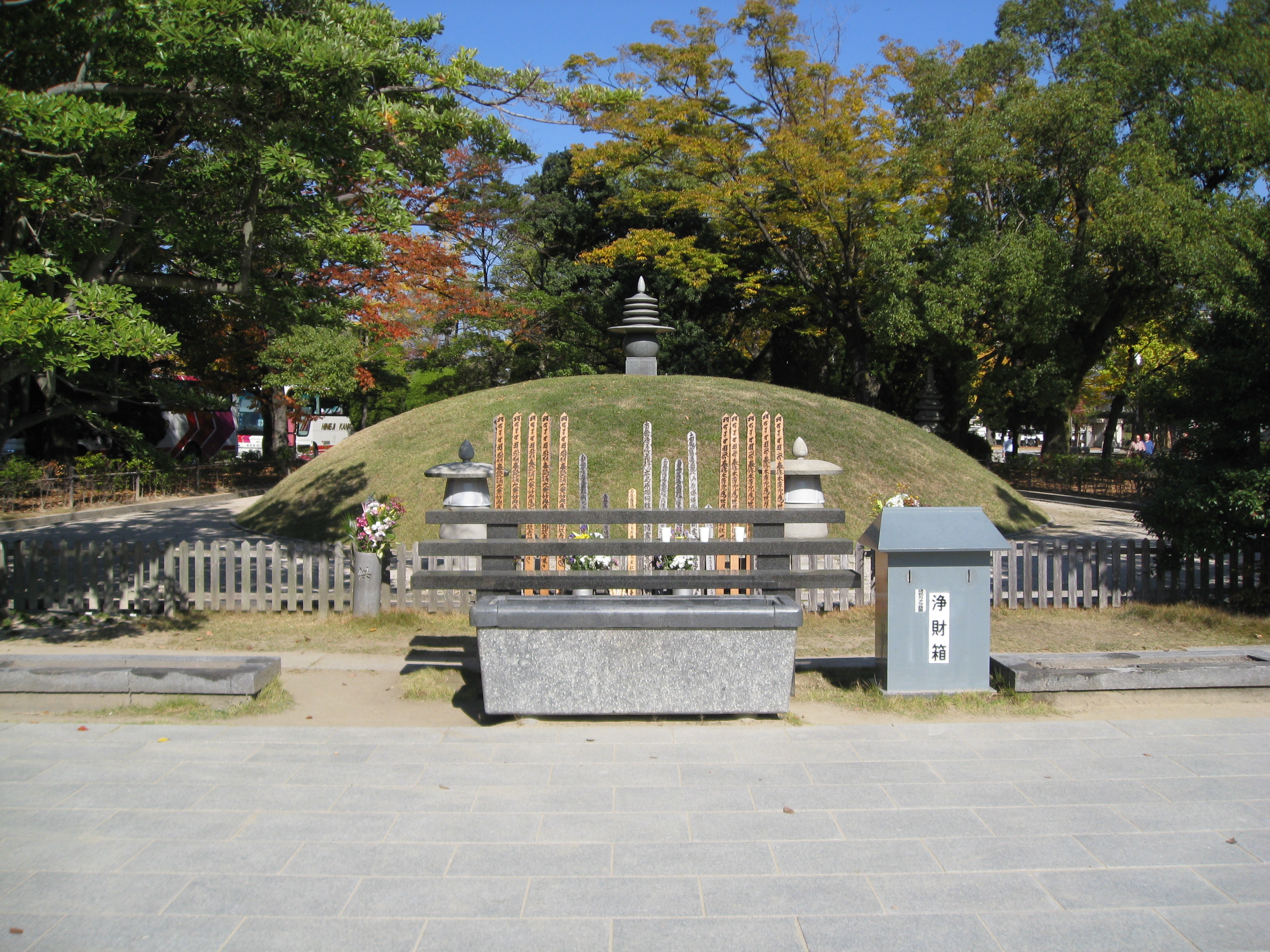
In the northwestern corner of the Hiroshima Peace Park, amid a quiet grove of trees, the earth suddenly swells. It is not much of a mound -- only about ten feet high and sixty feet across. Unlike most mounds, however, this one is hollow, and within it rests perhaps the greatest concentration of human residue in the world.rey clouds rising from sticks of incense hang in the air, spookily. Tourists do not dawdle here. Visitors searching for the Peace Bell, directly ahead, or the Children's Monument, down the path to the right, hurry past it without so much as a sideways glance. Still, it has a strange beauty: a lump of earth (not quite lush) topped by a small monument that resembles the tip of a pagoda.

On one side of the Memorial Mound the gray wooden fence has a gate, and down five steps from the gate is a door. Visitors are usually not allowed through that door, but occasionally the city of Hiroshima honors a request from a foreign journalist.

Inside the mound the ceiling is low, the light fluorescent. One has to stoop to stand. To the right and left, pine shelving lines the walls. Stacked neatly on the shelves, like cans of soup in a supermarket, are white porcelain canisters with Japanese lettering on the front. On the day I visited, there were more than a thousand cans in all, explained Masami Ohara, a city official. Each canister contained the ashes of one person killed by the atomic bomb.

Behind twin curtains on either side of an altar, several dozen pine boxes, the size of caskets, were stacked, unceremoniously, from floor to ceiling. They hold the ashes of about 70,000 unidentified victims of the bomb. If, in an instant, all of the residents of Wilmington, Delaware, or Santa Fe, New Mexico, were reduced to ashes, and those ashes carried away to one repository, this is all the room the remains would require.

More than 100,000 in Hiroshima were killed by The Bomb, the vast majority of them women and children, plus elderly males.  Fewer than one in ten were in the military. 

Most of those who died in Hiroshima were cremated quickly, partly to prevent an epidemic of disease. Others were efficiently turned to ash by the atomic bomb itself, death and cremation occurring in the same instant. Those reduced by human hands were cremated on makeshift altars at a temple that once stood at the present site of the mound, one-half mile from the hypocenter of the atomic blast.

In 1946, an Army Air Force squad, ordered by Gen. Douglas MacArthur to film the results of the massive U.S. aerial bombardment of Japanese cities during World War II, shot a solemn ceremony at the temple, capturing a young woman receiving a canister of ashes from a local official. That footage, and all of the rest that they filmed in Hiroshima and Nagasaki revealing the full aftermath of the bombings, would be suppressed by the United States for decades (as I probe in my book Atomic Cover-Up).

Later that year, survivors of the atomic bombing began contributing funds to build a permanent vault at this site and, in 1955, the Memorial Mound was completed. For several years the collection of ashes grew because remains of victims were still being found. One especially poignant pile was discovered at an elementary school.

The white cans (that's my photo) on the shelves have stood here for decades, unclaimed by family members or friends. In many cases, all of the victims' relatives and friends were killed by the bomb. Every year local newspapers publish the list of names written on the cans, and every year several canisters are finally claimed and transferred to family burial sites. Most of the unclaimed cans (a total of just over 800 in 2010, for example) will remain in the mound in perpetuity, now that so many years have passed.

They are a chilling sight. The cans are bright white, like the flash in the sky over Hiroshima at 8:15 a.m. on August 6, 1945. From all corners of the city the ashes were collected: the remains of soldiers, physicians, housewives, infants. Unclaimed, they at least have the dignity of a private urn, an identity, a life (if one were able to look into it) before death.

But what of the seventy thousand behind the curtains? The pine crates are marked with names of sites where the human dust and bits of bone were found -- a factory or a school, perhaps, or a neighborhood crematory. But beyond that, the ashes are anonymous. Thousands may still grieve for these victims but there is no dignity here. "They are all mixed together," said Ohara, "and will never be separated or identified." Under a mound, behind two curtains, inside a few pine boxes: This is what became of one-quarter of the city of Hiroshima on August 6, 1945.

My new book is  THE BEGINNING OR THE END: How Hollywood--and America--Learned to Stop Worrying and Love the Bomb,

Friday, August 5, 2022

Why Hiroshima Matters Today


Seventy-seven years after the atomic attacks on Hiroshima and Nagasaki, the bomb is still very much with us and controversy continues to swirl over the decision to obliterate the two Japanese cities.  My new book, The Beginning or the End: How Hollywood--and America--Learned to Stop Worrying and Love the Bomb, certainly puts this center stage.

Hiroshima, in any case, remains a vital lesson for us all, not only for the first use of a nuclear weapon there, but because of the “first use” nuclear policy the U.S. maintains today. 

Even the fact that the U.S. still has a first-strike policy (meaning we will use nukes first in a crisis if need be) will surprise many, especially with the end of the Cold War now a distant memory for some.

It’s a subject practically off-limits in the media and in American policy circles. Even the  antinuclear documentary Countdown to Zero, which outlined many serious nuclear dangers (from an accidental launch to a terror attack on America), failed to even mention the possibility that the U.S. might choose to use nuclear weapons again. Resisting a no-first-use pledge, in fact, has been a cornerstone of U.S. nuclear policy for decades.

Following a few positive signs from Obama, I fear that moving very far in the direction of no-first-use is still a long way off in Trump's America.

Perhaps the strongest reason is this: most Americans, our media and our leaders (including every president), have endorsed our “first-use” of the bomb against Japan. This remains true today, despite new evidence and analysis that has emerged for so many years. I’ve been probing this for over thirty years — in hundreds of articles, a new film, in three books — with little shift in the polls or change in heart among our policymakers and elected officials.

There has also been little change abroad — where the use of the bomb in 1945 has been roundly condemned from the beginning. Indeed, U.S. support, even pride, in our use of the weapon has given us little moral standing in arguing that other countries should not develop nuclear weapons and consider using them, possibly as a first, not a last, resort (that’s our policy, remember).

So it all goes back to Hiroshima and Nagasaki.

While I respect the views of a range of historians on this matter, and the opinions of the men who fought in the Pacific, I happen to believe the bombs should not have been used against Japan — directly over the center of massive cities — at that time. The war would likely have ended very shortly without it (the bloody American invasion was not set until months later), largely because of the Soviets finally declaring war on Japan — an event long-dreaded by Japanese leaders.

Yes, there was a day when conservatives like John Foster Dulles, columnist David Lawrence, Admiral William Leahy and General Dwight D. Eisenhower — “We shouldn’t have hit them with that awful thing,” Ike declared — clearly condemned the use of the bombs. They knew that the argument of “saving tens of thousands of American lives” only counted if an invasion actually was necessary. We had demanded “unconditional surrender,” dropped the bombs — then accepted the main Japanese demand, keeping their emperor as figurehead.

But the key point for today is this: how the “Hiroshima narrative” has been handed down to generations of Americans — and overwhelmingly endorsed by officials and the media, even if many historians disagree — matters greatly.

Over and over, top policymakers and commentators say, “We must never use nuclear weapons,” yet they endorse the two times the weapons have been used against cities in a first strike. To make any exceptions, even in the past — and in certainly a horrid situation — means exceptions can be made in the future. Indeed, we have already made two exceptions, with more than 200,000 civilians killed. The line against using nuclear weapons has been drawn... in the sand.

To cite just one example: Before our attack on Iraqi forces in Kuwait in 1990, then-Pentagon chief Dick Cheney said on TV that we would consider using nuclear weapons against Iraq but would hold off “at this point” — then specifically cited President Truman’s use of the bomb as morally correct. Some polls at the time showed strong support from the American public for using nukes if our military so advised.

And other polls since then show the same thing concerning other nuclear scenarios. Recent ones show as many as half of U.S. citizens would support on first-strike on Iran or North Korea--even if it might kill a million of more.

And, as I’ve noted, the fact that the United States first developed, and then used — twice — the WMD to end all WMDs has severely compromised our arguments against others building the weapon ever since. Hiroshima was our original sin, and we are still paying for it, even if most Americans do not recognize this.

That is why I always urge everyone to study the history surrounding the decision to use the bomb and how the full story was covered up for decades. (You could do worse than try my new book,  The Beginning or the End: How Hollywood--and America--Learned to Stop Worrying and Love the Bomb,)  There is certainly, in the minds of the media and the American public, no taboo on using nuclear weapons, and it all started, but did not end, with Hiroshima and Nagasaki. This is what nuclear abolitionists — or even those who simply want a partial easing of our first-use policy — are up against.

Friday, July 15, 2022

Countdown to Hiroshima: July 15, 1945

Every year at this time I trace the final days leading to the first use of the atomic bomb against two cities, Hiroshima and Nagasaki, in August 1945.   In this way the fateful, and in my view, tragic decisions made by President Truman, his advisers, and others, can be judged more clearly in "real time."  As some know, this is a subject that I have explored in hundreds of articles, thousands of posts,  and in three books, since 1984:  Hiroshima in America (with Robert Jay Lifton), Atomic Cover-up and last year's Hollywood epic, The Beginning or the End.   Now I've directed an award-winning documentary

So here is today's rather brief entry for July 15, on the eve of the first, fateful test of the new weapon, at the Trinity site, following two days of assembly by scientists and technicians nearby.  

We'll get into this more tomorrow, but just know that few precautions had been set for possibly evacuating local residents, despite the expected radioactive cloud and fallout generated and depending on the winds.  None were notified of the danger because of the top-secret nature of the bomb project and  media were in the dark as well.  Literally.  The test was set for the middle of the night, when nearly everyone in this remote area would be asleep, although this might guarantee that some kind of spectacular lighting at the horizon would be observed far away, perhaps even from Las Vegas.

Here is an excerpt on the final tension and mood from the Department of Energy's official history (that's General Groves with embedded New York Times reporter William L. Laurence above):

By 5:00 p.m. on the 15th, the device had been assembled and hoisted atop the 100-foot firing tower.  Leslie Groves, Vannevar Bush, James Conant, Ernest Lawrence, Thomas Farrell, James Chadwick, and others arrived in the test area, where it was pouring rain.  [Project leaders] Groves and J.  Robert Oppenheimer, standing at the S-10,000 control bunker, discussed what to do if the weather did not break in time for the scheduled 4:00 a.m. test.  
To break the tension, Enrico Fermi began offering anyone listening a wager on "whether or not the bomb would ignite the atmosphere, and if so, whether it would merely destroy New Mexico or destroy the world." 
Oppenheimer himself had bet ten dollars against George Kistiakowsky's entire month's pay that the bomb would not work at all. 

Tuesday, August 10, 2021

76 Years Ago: Truman Began the Story of Hiroshima With a Lie


Another post related to  my new book "The Beginning or the End"
 *
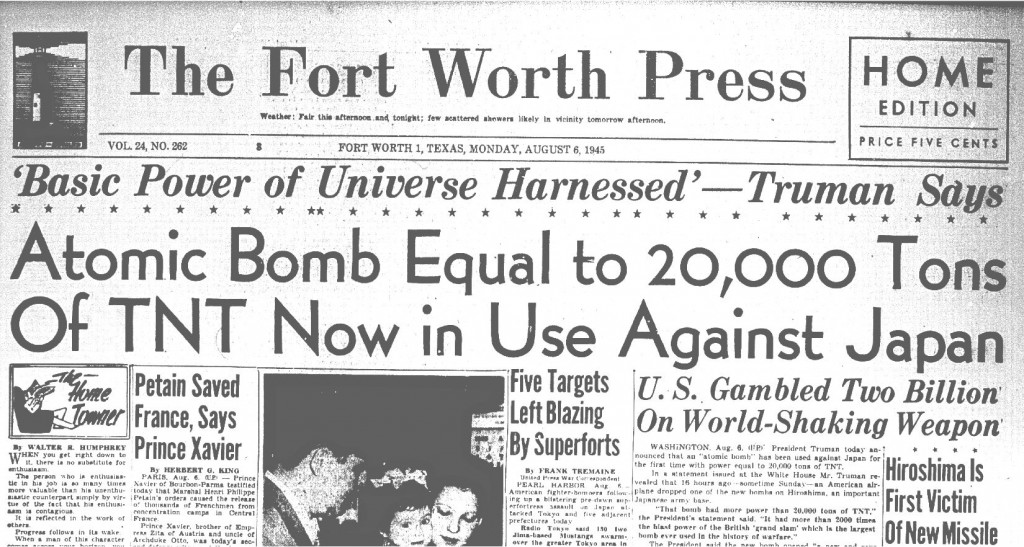
On Aug. 6, 1945, President Harry S. Truman faced the task of telling the press, and the world, that America’s crusade against fascism had culminated in exploding a revolutionary new weapon of extraordinary destructive power over a Japanese city.

It was vital that this event be understood as a reflection of dominant military power and at the same time consistent with American decency and concern for human life. Everyone involved in preparing the presidential statement sensed that the stakes were high, for this marked the unveiling of both the atomic bomb and the official narrative of Hiroshima.

When the astonishing news emerged that morning, exactly 74 years ago, it took the form of a routine press release, a little more than a thousand words long. President Truman was at sea a thousand miles away, returning from the Potsdam conference. The Soviet Union was hours from declaring war on Japan (“fini Japs” when that occurred, Truman had written days before in his diary).

Shortly before eleven o’clock, an information officer from the War Department arrived at the White House bearing bundles of press releases. A few minutes later, assistant press secretary Eben Ayers began reading the president’s announcement to about a dozen members of the Washington press corps.

The atmosphere was so casual, and the statement so momentous, that the reporters had difficulty grasping it. “The thing didn’t penetrate with most of them,” Ayers later remarked. Finally, they rushed to call their editors, and at least one reporter found a disbeliever at the other end of the line. The first few sentences of the statement set the tone:

“Sixteen hours ago an American airplane dropped one bomb on Hiroshima, an important Japanese Army base. That bomb had more power than 20,000 tons of TNT. ...The Japanese began the war from the air at Pearl Harbor. They have been repaid many fold. ...It is an atomic bomb. It is a harnessing of the basic power of the universe.”

Although details were modified at the last moment, Truman’s four-page statement had been crafted with considerable care over many months. From its very first words, however, the official narrative was built on a lie. Hiroshima was not an “army base” but a city of 350,000. It did contain one important military base, but the bomb had been aimed at the very center of a city (and far from its industrial area). This was a continuation of the American policy of bombing civilian populations in Japan to undermine the morale of the enemy. It was also to take advantage of what those who picked the target called the special “focusing effect” provided by the hills which surrounded the city on three sides. This would allow the blast to bounce back on the city, destroying more of it, and its citizens.

Perhaps 10,000 military personnel lost their lives in the bomb but the vast majority of the dead in Hiroshima would be women and children. Also: at least a dozen American POWs. When Nagasaki was A-bombed three days later it was officially described as a “naval base.”
There was something else missing in Truman’s announcement: Because the president in his statement failed to mention radiation effects, which officials knew were horrendous, the imagery of just a bigger bomb would prevail in the press. Truman described the new weapon as “revolutionary” but only in regard to the destruction it could cause, failing to mention its most lethal new feature: radiation.

Many Americans first heard the news from the radio, which broadcast the text of Truman’s statement shortly after its release. The afternoon papers quickly arrived with banner headlines: “Atom Bomb, World’s Greatest, Hits Japs!” and “Japan City Blasted by Atomic Bomb.” The Pentagon had released no pictures, so most of the newspapers relied on maps of Japan with Hiroshima circled.

It wasn’t until the following morning, Aug. 7, that the government’s press offensive appeared, with the first detailed account of the making of the atomic bomb, and the Hiroshima mission. Nearly every U.S. newspaper carried all or parts of 14 separate press releases distributed by the Pentagon several hours after the president’s announcement.

The Truman announcement of the atomic bombing on Aug. 6, 1945, and the flood of material from the War Department, firmly established the nuclear narrative.

One of the few early stories that did not come directly from the military was a wire service report filed by a journalist traveling with the president on the Atlantic, returning from Europe. Approved by military censors, it went beyond, but not far beyond, the measured tone of the president’s official statement. It depicted Truman, his voice “tense with excitement,” personally informing his shipmates about the atomic attack. “The experiment,” he announced, “has been an overwhelming success.”

The sailors were said to be “uproarious” over the news. “I guess I’ll get home sooner now,” was a typical response. (Whether the declaration of war by the Soviets might have produced surrender in a few days or weeks remains an open question.) Nowhere in the story, however, was there a strong sense of Truman’s reaction. Missing from this account was his exultant remark when the news of the bombing first reached the ship: “This is the greatest thing in history!”


Sunday, July 25, 2021

Countdown to Hiroshima: X-Minus 12 Days


Every year at this time, I trace the final days leading up to the first (and so far only) use of the atomic bomb against Hiroshima and Nagasaki  in August 1945. This is a subject that I have studied and written about in hundreds of articles and three books (including the new one, The Beginning or the End: How Hollywood--and America--Learned to Stop Worrying and Love the Bomb) since the early 1980s with a special emphasis on the aftermath of the bombings, and the government and media suppression in the decades after.  

Yesterday's entry.  Today:

July 25:  Still at Potsdam, Truman wrote in his diary this day an entry that raises the following:  Did he know that the U.S. was targeting the center of cities--the vast majority of citizens then living in the target cities were women and children--or was he lying to himself and history?   "We have discovered the most terrible bomb in the history of the world. It may be the fire destruction prophesied in the Euphrates Valley Era, after Noah and his fabulous Ark.  Anyway we ‘think’ we have found the way to cause a disintegration of the atom. An experiment in the New Mexico desert was startling - to put it mildly. ...The explosion was visible for more than 200 miles and audible for 40 miles and more.

"This weapon is to be used against Japan between now and August 10th. I have told the Sec. of War, Mr. Stimson, to use it so that military objectives and soldiers and sailors are the target and not women and children. Even if the Japs are savages, ruthless, merciless and fanatic, we as the leader of the world for the common welfare cannot drop that terrible bomb on the old capital or the new.

"He and I are in accord. The target will be a purely military one and we will issue a warning statement asking the Japs to surrender and save lives. I’m sure they will not do that, but we will have given them the chance. It is certainly a good thing for the world that Hitler’s crowd or Stalin’s did not discover this atomic bomb. It seems to be the most terrible thing ever discovered, but it can be made the most useful."   

Note:  "Military" made up only about 10% of the casualties in Hiroshima (including several American POWs), and 1% at most in Nagasaki (including Dutch POWs.). The vast majority of the 200,000  killed were women and children.